
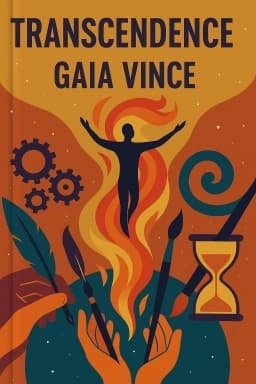
We Are Stardust: The Cosmic Origins of Humanity (And Why It Matters)
Discover how the universe’s wildest accidents made us—and why your atoms are older than the Earth itself.

Imagine looking in the mirror and seeing not just your reflection, but the story of the entire cosmos gazing back at you. The calcium in your bones, the iron in your blood, the oxygen in your lungs—all were forged in the fiery crucibles of ancient stars. Our planet, our bodies, our very thoughts are the products of cosmic accidents, random collisions, and the slow dance of galaxies. This isn’t poetic exaggeration; it’s scientific fact, and it’s the starting point of Gaia Vince’s remarkable book, Transcendence. 1
Billions of years ago, in a universe still finding its shape, stars lived and died in violent explosions. These supernovae scattered the building blocks of life across the cosmos. Some of this stardust coalesced to form our solar system—a planetary system born from the debris of countless cosmic ancestors. Fast forward through time: a rogue asteroid wipes out the dinosaurs, opening the door for mammals to rise. Another chance event—the collision that formed our moon—gave Earth its stabilizing tilt and seasons, making complex life possible. 3
Why does this matter? Because it means that every one of us is connected, not just to each other or to the living world, but to the universe itself. Our existence is a miracle of chance, a testament to the power of randomness and resilience. Understanding this cosmic perspective can be profoundly healing. It reminds us that we are not alone, not insignificant, but part of a vast, ongoing story. It’s a story that continues every time you breathe, dream, or look up at the stars.
So next time you feel small or disconnected, remember: you are the universe, thinking about itself. And the story is just beginning.
Want to explore more insights from this book?
Read the full book summary