
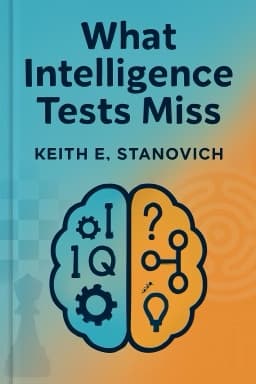
Why Your IQ Doesn’t Tell the Whole Story: The Hidden Science of Rationality
Discover why being smart isn’t enough and how rationality shapes your decisions and happiness.

For decades, intelligence quotient (IQ) tests have been the gold standard for measuring human intellect. They assess how quickly and accurately we can solve puzzles, reason abstractly, and recall facts. But what if these tests only capture part of what it means to think well?
Intelligence tests measure specific cognitive skills such as fluid intelligence—the ability to solve novel problems—and crystallized intelligence—the knowledge we accumulate. However, they overlook crucial mental faculties that govern how we form beliefs and make decisions under uncertainty. This gap explains why some individuals with high IQs still make irrational financial choices, cling to false beliefs, or fall victim to cognitive biases.
One of the most revealing concepts is dysrationalia, the phenomenon where intelligent people consistently fail to think or behave rationally. Imagine a brilliant mathematician investing recklessly or a well-educated professional ignoring evidence that contradicts their worldview. Dysrationalia highlights that intelligence tests do not assess the disposition or skill to use one's intellect wisely.
Our minds operate through a complex architecture involving three interacting systems: the autonomous mind (fast, automatic processing), the algorithmic mind (cognitive capacity measured by IQ), and the reflective mind (thinking dispositions). While IQ tests assess the algorithmic mind, the reflective mind governs whether we apply our cognitive resources rationally. This explains why mental horsepower alone is insufficient for sound judgment.
Moreover, humans are cognitive misers. We prefer mental shortcuts—heuristics—that conserve effort but can lead to predictable errors. For example, framing effects demonstrate how the presentation of choices dramatically alters decisions, even when outcomes are identical. Recognizing these tendencies helps us understand the limits of our thinking and the importance of deliberate reflection.
Another critical insight is the role of mindware—the rules, strategies, and knowledge that enable rational thought. Gaps in mindware, such as misunderstanding probability or logic, cause irrational decisions despite intelligence. Worse yet, contaminated mindware—faulty or biased knowledge like superstitions or conspiracy theories—further impairs reasoning.
Understanding these distinctions opens the door to improving rationality through education and training, enhancing both personal well-being and societal outcomes. As rational thinking skills grow, so do our chances of making better decisions, achieving goals, and living happier lives.
In conclusion, intelligence is a vital but incomplete measure of our cognitive abilities. To truly think well, we must cultivate rationality—the skill and disposition to use our minds wisely. This journey promises a richer understanding of ourselves and a brighter future.
Sources: Amazon reviews on rationality and intelligence, Project Syndicate commentary on cognitive science, New York Times insights on rationality training, Goodreads discussions on rationality vs intelligence 1 3 4 2
Want to explore more insights from this book?
Read the full book summary