
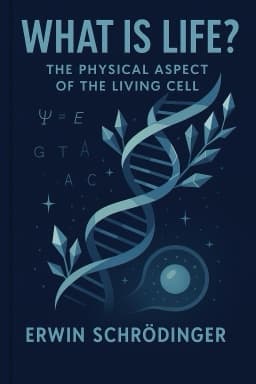
Entropy, Order, and the Secret War Inside Every Cell
How Living Things Cheat Death with Physics

How Living Things Cheat Death with Physics
Why don’t living things just fall apart? Why do we grow, heal, and reproduce, when everything else in the universe seems to break down and decay? Schrödinger’s answer is both elegant and profound: life feeds on negative entropy. In other words, organisms import order from their environment—food, sunlight, even air—and use it to build and sustain themselves. The price? They export disorder back into the world. This is why you need to eat, why plants need sunlight, and why every breath is an act of defiance against the universe’s tendency toward chaos.
Inside every cell, a war is raging. Metabolic pathways capture energy, channel it into building proteins and repairing DNA, and fight the slow creep of entropy. But the battle can’t last forever. As we age, our ability to import and use negative entropy declines. Systems break down, errors accumulate, and disorder wins. Aging, in this view, is not just a biological process—it’s a thermodynamic inevitability.
This idea has had a huge impact outside biology. It inspired the fields of cybernetics (the science of control and communication) and information theory, which now shape everything from the internet to artificial intelligence. It’s also central to ecology and sustainability: ecosystems, like organisms, are islands of order in a sea of entropy.
Understanding entropy is key to tackling the grand challenges of our time, from aging and disease to climate change. Schrödinger’s insight reminds us that life is a delicate balance, a temporary victory of order over chaos. The real question is: how long can we keep winning?
Sources: The Guardian, ScienceDirect, JSTOR
Want to explore more insights from this book?
Read the full book summary