
From Quantum Jumps to DNA: The Real Science Behind Life’s Code
How Schrödinger’s Wildest Ideas Predicted the Age of Genomics

How Schrödinger’s Wildest Ideas Predicted the Age of Genomics
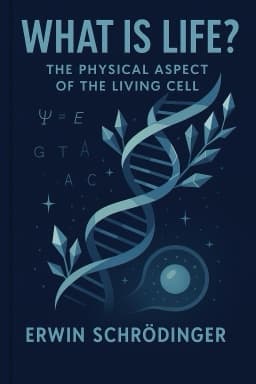
What if the secret to life was hidden not in the slow grind of chemistry, but in the wild, unpredictable world of quantum physics? That’s the bold claim Erwin Schrödinger made in ‘What is Life?’—and it’s a claim that has aged remarkably well. Schrödinger argued that the stability of genes, their uncanny ability to persist unchanged over centuries, could only be explained by the quantum energy barriers that protect their structure. Genes, he said, are like aperiodic crystals: unique, information-rich molecules that resist the chaos of heat and time.
But Schrödinger didn’t stop there. He proposed that genetic mutations—the raw material of evolution—are not gradual, but sudden, quantum events. An X-ray, for example, can trigger a mutation by causing a rare, high-energy jump in a gene’s configuration. This idea was proven right within a decade, as scientists learned to induce mutations with radiation and track their inheritance. Today, we know that quantum effects play a crucial role in everything from enzyme reactions to photosynthesis, and the field of quantum biology is booming.
The aperiodic crystal idea was Schrödinger’s greatest gift to science. It directly inspired Watson and Crick’s search for DNA’s structure, leading to the double helix model that launched the genomics era. Now, we can read, write, and edit genetic code, opening doors to personalized medicine, gene therapy, and even the creation of synthetic life. Schrödinger’s vision is alive in every CRISPR experiment and every search for extraterrestrial biosignatures.
So, what does this mean for the future? It means the boundaries between physics, biology, and information science are dissolving. The next breakthroughs will come from thinkers who, like Schrödinger, dare to cross disciplines and imagine the impossible. The quantum code of life is not just a metaphor—it’s the blueprint for the next century of discovery.
Sources: JSTOR, ScienceDirect, The Guardian
Want to explore more insights from this book?
Read the full book summary