
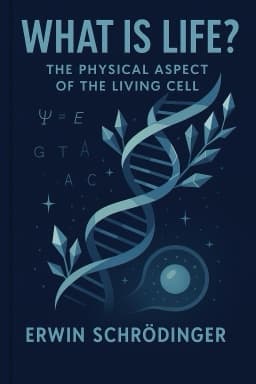
The Book That Launched a Thousand Discoveries: Schrödinger’s Legacy in Modern Science
How ‘What is Life?’ Sparked the Age of DNA, Computing, and Beyond

How ‘What is Life?’ Sparked the Age of DNA, Computing, and Beyond
Few books can claim to have changed the course of history, but Erwin Schrödinger’s ‘What is Life?’ did just that. Its influence stretches from the discovery of DNA’s structure to the birth of information theory, the rise of artificial intelligence, and the ongoing quest for extraterrestrial life. Watson and Crick, the discoverers of the double helix, credited Schrödinger’s idea of the ‘aperiodic crystal’ as their inspiration. But the ripple effects didn’t stop there.
Schrödinger’s concept of the genetic code as information storage laid the groundwork for Claude Shannon’s information theory, which now underpins all digital technology. The idea that life is a process of copying and transmitting information has shaped fields as diverse as neuroscience, robotics, and astrobiology. The structure of DNA, gene editing, the Human Genome Project—all trace their roots to the questions Schrödinger dared to ask.
Even today, as we edit genes, build synthetic organisms, and search for life beyond Earth, Schrödinger’s legacy is everywhere. His humility and curiosity remind us that science is a living process, always unfinished, always open to new ideas. The future belongs to those who, like Schrödinger, are unafraid to cross boundaries and imagine new worlds.
‘What is Life?’ is not just a book—it’s a launchpad for the greatest discoveries of our time.
Sources: The Guardian, ScienceDirect, JSTOR
Want to explore more insights from this book?
Read the full book summary