
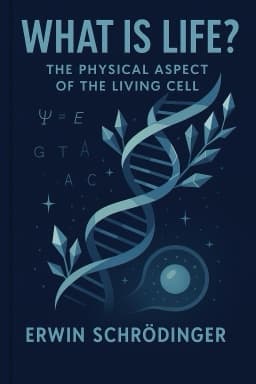
The Unity of Mind: Schrödinger, Consciousness, and the Science of Self
What ‘What is Life?’ Teaches Us About Who We Really Are

What ‘What is Life?’ Teaches Us About Who We Really Are
Is your mind really your own? Or are you, in some deep sense, part of something greater? In the final pages of ‘What is Life?’, Schrödinger drops a philosophical bomb: the plurality of minds is only an appearance. Drawing inspiration from the Upanishads, he suggests that beneath the surface, all consciousness is one. This idea is as radical now as it was then, challenging everything from neuroscience to artificial intelligence.
The science of consciousness is still in its infancy, but Schrödinger’s insight resonates with new research on brain networks, collective intelligence, and the emergent properties of mind. Meditation and mindfulness practices, rooted in the same Eastern philosophies, now find support in neuroscience, revealing how the illusion of separateness can dissolve in certain mental states.
Why does this matter? Because it shapes our ethics, our politics, and our vision for the future. If consciousness is fundamentally unified, then compassion, cooperation, and empathy are not just moral choices—they are reflections of our deepest reality. As AI and biotechnology blur the boundaries between self and other, Schrödinger’s vision offers a guide for navigating a world where the question of who ‘we’ are is more urgent than ever.
Ultimately, ‘What is Life?’ is not just a book about biology. It’s a meditation on existence, a call to humility, and a reminder that the boundaries we draw are, perhaps, only skin deep.
Sources: JSTOR, The Guardian, ScienceDirect
Want to explore more insights from this book?
Read the full book summary