
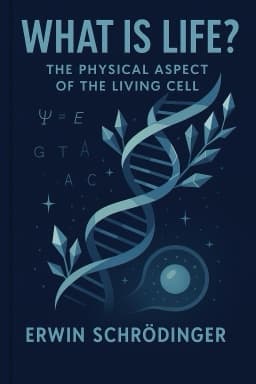
Why Schrödinger’s ‘What is Life?’ Still Blows Minds in 2025
How a Physicist’s Little Book Changed Biology Forever

How a Physicist’s Little Book Changed Biology Forever
If you’ve ever wondered how the secrets of life were cracked open, you need to meet Erwin Schrödinger—not just the quantum physicist, but the poetic rebel who, in 1944, dared to ask: What is life? In a world still reeling from war, Schrödinger’s lectures (and then his book) landed like a meteor. He posed a question both simple and profound: How can a living cell, made of ordinary atoms, maintain such extraordinary order and pass it on, generation after generation?
Schrödinger’s answer was radical. He proposed that life’s secret lay in a molecular ‘code-script’—a structure that could store information with almost miraculous stability. This was not just a metaphor. He argued that genes must be like ‘aperiodic crystals’: unique, non-repeating molecular patterns capable of carrying complex instructions. This idea, more than any other, inspired the young James Watson and Francis Crick. Their discovery of DNA’s double helix just nine years later was a direct realization of Schrödinger’s vision, and it ushered in the age of molecular biology.
But the book’s influence goes far beyond genetics. Schrödinger asked how living things maintain order in a world ruled by entropy and decay. His answer? Life feeds on ‘negative entropy’—importing order from the environment and exporting disorder. This concept would later echo in the birth of information theory and cybernetics, and now underpins everything from neuroscience to artificial intelligence.
Schrödinger’s humility shines throughout. He admits biology is not his field, warns he may be wrong, and yet, with the outsider’s eye, he sees connections others missed. He is fearless in his speculation, linking quantum jumps to genetic mutations and suggesting that the unity of consciousness might be a deeper reality than the apparent plurality of minds. These ideas, once fringe, are now alive in debates about quantum biology and the nature of mind.
Today, ‘What is Life?’ remains a touchstone for anyone grappling with the big questions: How does life begin? How does information shape matter? Can consciousness be explained by physics? Schrödinger’s legacy is not just in the answers he gave, but in the courage to ask—and to keep asking—what it means to be alive.
So, why does this book still blow minds? Because it’s not just about biology. It’s about the unity of knowledge, the audacity to cross boundaries, and the humility to admit what we don’t know. It’s about the endless, exhilarating quest to understand ourselves and our place in the universe. If you haven’t read it, you’re missing the book that changed everything.
Sources: The Guardian, ScienceDirect, JSTOR
Want to explore more insights from this book?
Read the full book summary