
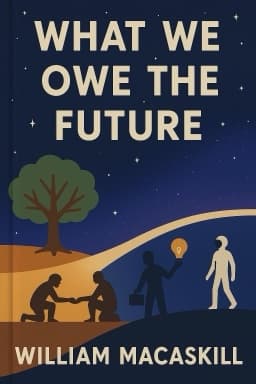
Unlocking the Secrets of Longtermism: How Caring About the Future Can Change Everything
Explore the surprising ways longtermism reshapes our ethical landscape and what it means for technology and society.

The Ethical Imperative to Care for Future Generations
Longtermism challenges us to rethink our moral priorities by recognizing that the number of future people could be trillions, vastly outnumbering those alive today. This sheer scale means that even small improvements or harms could have enormous cumulative effects.
Evaluating Long-Term Impact
To navigate the complexity of influencing the future, a framework examining significance, persistence, and contingency helps us understand how actions resonate over time. Historical examples, such as the extinction of megafauna coinciding with human arrival and early agricultural burning, demonstrate how even ancient actions have lasting consequences.
Moral Revolutions and Their Fragility
The abolition of slavery stands as a testament to how moral values can change drastically, driven by courageous activism despite economic incentives to maintain the status quo. This change was contingent on specific historical conditions and could have been delayed or reversed.
Risks of Value Lock-In in the Age of AI
Value lock-in occurs when dominant moral frameworks become rigid and resistant to change. The rise of advanced AI introduces new challenges, as software can preserve encoded values indefinitely, potentially freezing society’s moral landscape.
Promoting Moral Diversity and Cooperation
Encouraging diverse viewpoints, free expression, and migration fosters a dynamic moral environment where values can be tested and improved. Constructive negotiation between differing groups builds durable solutions and social cohesion.
Confronting Existential Threats
Humanity faces multiple existential risks, including nuclear conflict, engineered pandemics, and climate change. Successes like asteroid detection programs demonstrate that mitigation is possible with coordinated effort.
Philosophical Foundations and Overcoming Skepticism
Longtermism’s ethical foundation rests on frameworks like expected value theory, which guide decisions under uncertainty by weighing potential outcomes. Common critiques—such as discounting the interests of future people or doubting our influence—are addressed through reasoned arguments emphasizing the magnitude of what is at stake.
Ultimately, caring for the distant future is not just an abstract ideal but a practical moral imperative that challenges us to rethink our role in history and the legacy we leave behind.
Want to explore more insights from this book?
Read the full book summary