
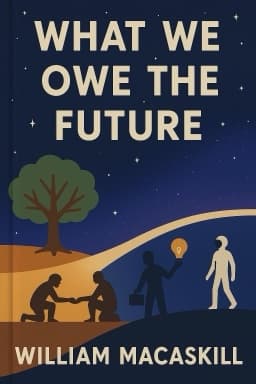
Why Your Choices Today Could Shape Humanity’s Future for Millennia — And How to Make Them Count
Discover the profound ethical imperative to care for future generations and the transformational power of our present decisions.

Understanding the Immensity of the Future
Imagine living every human life ever, one after another, spanning nearly four trillion years. This staggering timescale dwarfs our everyday experience and places our current moment as a mere blink in the vast timeline of humanity. This perspective reveals a profound ethical insight: future generations far outnumber us and have moral significance equal to our own. Yet, they are completely disenfranchised, unable to vote or speak for themselves. Recognizing this calls us to expand our moral concern beyond the present, embracing a longterm view that values all humans regardless of when they live.
How Our Actions Ripple Through Time
History shows that our choices ripple far beyond their immediate effects. Early humans caused the extinction of giant animals and started deforestation practices whose impacts persist today. To assess such long-term impacts, a framework considering significance, persistence, and contingency helps us understand how much value is added, how long effects last, and how dependent changes are on specific actions. Think of history as molten glass that cools and hardens, limiting future change. This metaphor illustrates why certain historical moments are critical windows to shape civilization’s trajectory.
The Power and Fragility of Moral Change
The abolition of slavery exemplifies a profound moral revolution that transformed millions of lives. Despite its profitability and deep entrenchment, slavery was ended through the determined activism of a small group, highlighting that moral progress is not guaranteed but contingent on specific conditions and courageous action. This reminds us that our values can shift dramatically, but such changes require effort and are vulnerable to reversal.
Value Lock-In and Emerging Technologies
While moral change is powerful, values can become locked in, forming rigid orthodoxy resistant to change. Ancient examples show how enforced ideologies can be short-lived without broad support. Today, advanced AI introduces the possibility of encoding values that persist indefinitely, raising questions about whether future societies will remain open or ossify. Guiding AI development with care is crucial to ensure beneficial value lock-in rather than harmful rigidity.
Fostering a Morally Exploratory Future
Hope lies in encouraging moral diversity, free speech, and cooperation. Societies that embrace multiple perspectives tend to innovate and adapt better. Migration spreads ideas and values, accelerating moral progress. Constructive dialogue between opposing groups builds lasting solutions. By nurturing openness and collaboration, civilization can avoid premature lock-in and promote ongoing moral evolution.
Facing Existential Risks
Humanity confronts risks capable of ending civilization or causing extinction, including nuclear war, engineered pandemics, and climate change. Yet, coordinated efforts like asteroid detection show how risks can be mitigated. Vigilance, governance, and scientific innovation are essential to safeguard the future. The stakes could not be higher, as preventing collapse preserves the vast future we envision.
Philosophical Foundations and Embracing Longtermism
Longtermism rests on ethical reasoning that prioritizes the long-term future using tools like expected value theory to guide decisions under uncertainty. Common objections—such as discounting future interests or doubting influence—are addressed through careful moral analysis. Embracing longtermism expands our moral circle to include countless future generations, inspiring hope and action to build a flourishing legacy.
In sum, the future is not a gift handed down but an achievement we must build together. Our choices today echo through eternity, shaping a legacy of justice, kindness, and flourishing for all who come after us.
Want to explore more insights from this book?
Read the full book summary