
The Infinite and the Unknowable: How Gödel, Cantor, and Turing Redefined the Limits of Knowledge
From Paradoxes to Proofs: The Human Drama Behind the Most Mind-Bending Ideas in Math

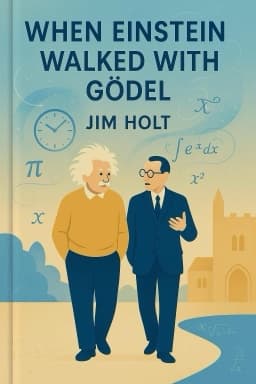
What if some truths can never be proven? What if infinity isn’t just endless, but comes in different sizes? And what if there are questions no computer can ever answer? These are not just abstract puzzles—they are the legacy of three extraordinary thinkers: Kurt Gödel, Georg Cantor, and Alan Turing. Their work, chronicled in Jim Holt’s 'When Einstein Walked with Gödel,' marks a turning point in the history of ideas, where certainty gave way to wonder and humility.
Gödel stunned the mathematical world by proving that any sufficiently complex logical system will contain true statements that cannot be proven within that system. This wasn’t just a technical result—it was a philosophical earthquake, showing that the dream of complete knowledge was forever out of reach. Cantor, meanwhile, dared to explore the infinite, discovering that there are countable and uncountable infinities, each with its own paradoxes. His work, initially dismissed as madness, now forms the bedrock of modern set theory. Turing, building on these ideas, showed that no algorithm can solve every problem—the famous Halting Problem—setting the stage for computer science and the digital revolution.
Yet, these breakthroughs came at a cost. Cantor suffered bouts of depression, Gödel became increasingly paranoid, and Turing’s life ended in tragedy after years of persecution. Their stories remind us that the pursuit of knowledge is as much about courage and resilience as it is about logic and proof. The limits of mathematics are not failures, but invitations—to imagine, to create, and to seek meaning beyond the boundaries of reason.
In the end, the infinite and the unknowable are not obstacles, but sources of inspiration. They teach us that the world is richer and stranger than we can ever fully grasp—and that the journey of discovery is as important as the destination.
Want to explore more insights from this book?
Read the full book summary