
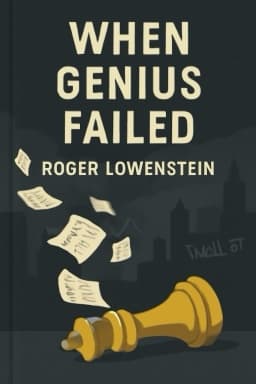
How Hubris Toppled Wall Street’s Brightest Minds: Lessons from 'When Genius Failed'
The dramatic story behind Long-Term Capital Management’s rise and fall—and what it means for investors today.

The Rise of a Dream Team
Imagine a team so brilliant that investors around the world clamored to hand them their fortunes. That was Long-Term Capital Management (LTCM) in the early 1990s—a hedge fund founded by John Meriwether and staffed with Nobel Prize-winning economists like Robert Merton and Myron Scholes. Their promise was simple yet irresistible: using advanced mathematical models, they would identify tiny inefficiencies in global markets and exploit them for near-riskless profits.
The Alchemy of Models—and the Seduction of Certainty
LTCM’s partners believed they had cracked the code of finance. Their strategies, built on the Black-Scholes model and continuous-time finance, seemed to deliver steady, outsized returns. The fund’s early years were a triumph, with double-digit gains and a reputation for genius that only grew. But beneath the surface, their success was built on assumptions—that markets were rational, that rare events were truly rare, and that their models could capture the unpredictable dance of human behavior.
Leverage: The Magic Multiplier—and Its Perils
To turn small opportunities into massive profits, LTCM borrowed heavily—up to 30 times its capital at the peak. This leverage magnified every gain, but also every loss. The partners negotiated favorable terms with banks, often refusing standard collateral requirements. As their trades grew in complexity and size, so did their exposure to the interconnected web of global finance.
The Storm Breaks: Russia and the Crisis of Confidence
The Russian government’s default in 1998 was the stone that shattered LTCM’s carefully constructed world. Suddenly, markets across the globe moved in unison—assets that were supposed to be uncorrelated fell together. The fund’s models, built on historical data, failed to predict the panic and contagion that followed. Margin calls arrived in waves. LTCM was forced to sell assets at fire-sale prices, accelerating the downward spiral. What had seemed like a fortress of intellect was revealed to be a house of cards.
Rescue on Wall Street: The Night the Banks Came Together
With LTCM on the brink, the Federal Reserve Bank of New York convened the heads of Wall Street’s biggest banks for an emergency rescue. Rivals became allies in a desperate bid to stave off a global meltdown. In a tense boardroom, deals were struck, capital was injected, and disaster was averted—at least for the system, if not for LTCM’s investors. This unprecedented intervention set the stage for future debates about 'too big to fail' and the role of central banks in crises.
Legacy: Humility, Risk, and the Limits of Genius
In the aftermath, the financial world was forever changed. LTCM’s collapse led to new risk management standards, more rigorous stress testing, and a renewed appreciation for the limits of mathematical models. The story became a staple in business schools—a cautionary tale about the dangers of overconfidence and the enduring need for humility.
Conclusion: Genius Is Not Enough
'When Genius Failed' is more than a chronicle of one fund’s demise—it’s a meditation on the nature of risk, the perils of certainty, and the enduring quest for understanding in a world that resists prediction. For anyone who invests, manages risk, or simply wonders how intellect and ambition can sometimes lead us astray, this story is as relevant today as ever.
Want to explore more insights from this book?
Read the full book summary