
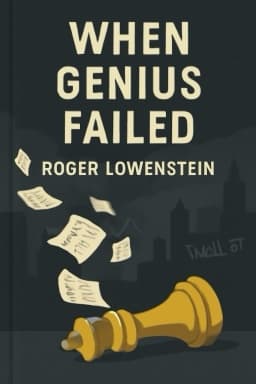
The Hidden Dangers of Mathematical Models: What 'When Genius Failed' Teaches Us About Risk
Why even the most brilliant models can’t predict the future—and how LTCM’s collapse changed finance forever.

The Seduction of Certainty
It’s easy to be dazzled by numbers. LTCM’s founders were pioneers in quantitative finance, wielding models that promised to transform uncertainty into manageable risk. Their strategies relied on the Black-Scholes formula, which revolutionized option pricing, and on sophisticated simulations of market movements. Investors and regulators alike were seduced by the apparent precision of these tools.
Assumptions and Blind Spots
But every model is built on assumptions. LTCM’s partners assumed that markets were efficient, that rare events were rare, and that correlations between assets would hold steady. In reality, markets are shaped by human psychology, unpredictable events, and feedback loops. When the Russian default hit, these assumptions collapsed—and so did LTCM’s models.
From Small Errors to Systemic Risk
The real danger of quantitative models is not just in their limitations, but in the false sense of security they create. LTCM’s managers believed their strategies were nearly risk-free, leading them to take on enormous leverage. When the models failed, the losses were magnified—and threatened to bring down the entire financial system.
Lessons for the Modern Investor
Today, the legacy of LTCM is everywhere. Modern risk management demands stress testing, scenario planning, and humility in the face of uncertainty. The story of 'When Genius Failed' is a reminder that models are tools, not oracles—and that even the brightest minds can be blindsided by the unknown.
Conclusion: Embrace Uncertainty
As finance grows ever more complex, the temptation to seek certainty in numbers remains strong. But the true wisdom, as Lowenstein’s book shows, lies in embracing uncertainty, questioning assumptions, and preparing for the unexpected. The story of LTCM is a testament to both the power and the peril of mathematical genius.
Want to explore more insights from this book?
Read the full book summary