
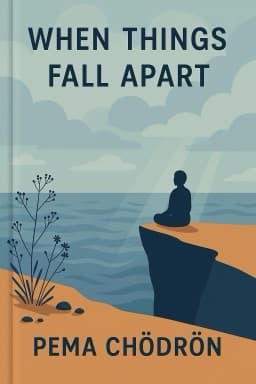
Why Embracing Chaos Might Be the Best Thing You Ever Do: Lessons from 'When Things Fall Apart'
Discover how finding peace in the mess can transform your life

Discover how finding peace in the mess can transform your life
Imagine standing in the center of a storm—wind howling, rain lashing, the world around you dissolving into uncertainty. Most of us spend our lives trying to avoid these moments, clinging to routines, relationships, and beliefs that promise safety. But what if the storm itself is your greatest teacher? In 'When Things Fall Apart,' Pema Chödrön offers a radical invitation: instead of running from chaos, what if you leaned in?
Chödrön’s voice is gentle but unflinching. She doesn’t sugarcoat the truth: pain and uncertainty are inevitable. We all experience loss, disappointment, fear, and sometimes even despair. Yet, she insists, it’s precisely in these moments of groundlessness that true transformation is possible. The Buddhist teachings she shares are not about escape or self-improvement—they’re about befriending our own hearts, exactly as they are, in the midst of the storm.
Learning to Stay
One of the book’s most powerful lessons is the practice of staying. When faced with pain or fear, our first instinct is to distract ourselves—scrolling through phones, binge-watching shows, or diving into work. Chödrön suggests something revolutionary: pause. Breathe. Notice what’s happening inside you. This practice, known as 'learning to stay,' is the foundation of resilience. It teaches us that we don’t have to fix, fight, or flee. We can simply be, and in that being, we find unexpected strength.
Groundlessness: The Gift of Not Knowing
Perhaps the most chilling—and liberating—idea in the book is that there is no solid ground. Life is unpredictable, and any sense of certainty is fleeting. Rather than seeing this as a problem, Chödrön encourages us to see groundlessness as a gift. When we let go of our need for control, we open to the richness of the present moment. We become more flexible, creative, and compassionate—both with ourselves and others.
Letting Go of Hope (Yes, Really)
This might sound counterintuitive, but Chödrön argues that hope, as we usually understand it, can be a trap. Hoping for a pain-free life or a perfect future keeps us from fully engaging with what is. By releasing our attachment to outcomes, we relax into a deeper confidence—one that is not dependent on things going our way. This is not about despair, but about discovering a peace that doesn’t depend on circumstances.
Self-Compassion: The Heart of Healing
Time and again, readers write to Chödrön saying they feel like the worst person in the world. Her response is always the same: be gentle. The practice of maitri, or unconditional friendliness toward oneself, is the cornerstone of healing. Instead of judging or trying to improve ourselves, we learn to sit with our flaws, fears, and failures as we would with a dear friend. This radical acceptance, she writes, is the soil in which resilience grows.
Practical Tools for Everyday Life
Throughout the book, Chödrön offers simple, actionable practices—pausing before reacting, breathing into discomfort, and noticing the subtle ways we cause harm to ourselves and others. These tools are not meant to fix us, but to help us become more present and compassionate in every moment.
Real-Life Examples
From stories of spiritual seekers locked in huts with snakes to everyday moments of heartbreak and recovery, the book is filled with examples that ground its teachings in real life. Readers will find themselves reflected in these tales, gaining hope and courage from the shared human journey.
In the end, 'When Things Fall Apart' is less a manual for fixing your life and more a guide to living fully, bravely, and kindly—no matter what comes your way. If you’re ready to transform chaos into growth, this book—and this blog—will show you how to begin.
References: Lessons from reading 'When Things Fall Apart' by Pema Chödrön
1
, When Things Fall Apart Summary
2
, Key Insights
4
Want to explore more insights from this book?
Read the full book summary