
Why Your Brain Craves God: The Neuroscience Behind Religious Belief and Ritual
Explore the biological roots of faith and how rituals shape our spiritual minds.

Religion is a universal human phenomenon, but why does the brain crave it? The answer lies deep within our neurological wiring and evolutionary history. Humans possess cognitive functions that drive us to create meaning, organize reality, and seek certainty — all of which religion powerfully addresses.
One key cognitive function is the binary operator, which frames the world in opposites such as good and evil, life and death. This simplification helps the mind manage complex existential dilemmas. Another is the existential operator, which assigns reality and existence to perceptions, enabling faith in unseen truths.
Myth-making arose as a biological imperative, helping early humans cope with the fear of death and suffering. Neanderthal burial rituals suggest an early awareness of an afterlife, illustrating the deep roots of spiritual belief. Rituals then evolved to physically express these stories, using rhythmic, repetitive behaviors to alter brain states.
Rituals stimulate the limbic system and quiet the orientation association area, reducing the sense of isolated selfhood and fostering feelings of unity and transcendence. These neurological changes promote social cohesion, reduce aggression, and enhance group survival — explaining religion’s persistence through natural selection.
Scientific studies also show that religious involvement correlates with better physical and mental health, thanks to social support and stress reduction. This biological and psychological synergy makes religion a powerful force in human life.
By understanding these brain mechanisms, we can appreciate religion as a natural and adaptive expression of our humanity rather than mere superstition. It reveals why faith continues to inspire, comfort, and unite billions worldwide.
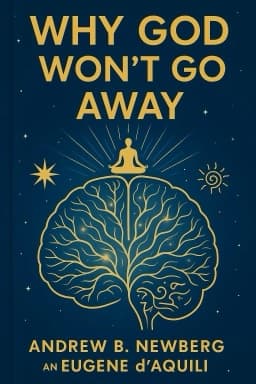
For a deeper dive, books like Andrew Newberg’s
Want to explore more insights from this book?
Read the full book summary