
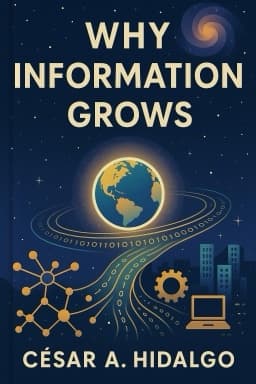
Unlocking the Hidden Code of the Economy: How Economic Complexity Shapes Our Future
Discover the surprising science behind why some countries thrive and others struggle, and how knowledge is the real currency of progress.

Introduction: Beyond Traditional Economics
For decades, economists have sought to explain why some countries flourish while others falter. Conventional wisdom pointed to factors like capital investment, labor force size, or natural resource endowment. Yet, these explanations often fell short of capturing the nuanced realities of global development. Enter the concept of economic complexity — a transformative lens that uncovers the hidden code of knowledge embedded in economies.
The Physical Roots of Information
At the heart of economic complexity lies a profound truth: information is physical. It's not just abstract data floating in the ether but the specific arrangement of atoms and matter. Consider how the atoms in a luxury car are arranged to create a masterpiece of engineering — this physical order embodies knowledge.
From Energy Flows to Durable Knowledge
Energy flowing through systems creates pockets of order. Think of a whirlpool forming in draining water or the crystalline structure of DNA. These stable, information-rich structures endure, enabling life and complex societies. Solids, especially aperiodic crystals, preserve information against entropy, allowing knowledge to be stored and transmitted across generations. This physical durability is essential for the accumulation of knowhow that underpins economic complexity.
Human Imagination Made Real
What sets humans apart is the ability to crystallize imagination into products. Every smartphone, vehicle, or tool embodies countless hours of tacit knowledge and creativity. These products are not just objects but repositories of collective intelligence, extending human capabilities. International trade reflects this flow of embodied imagination, where raw materials are transformed into complex goods through networks of knowledge and collaboration.
Limits of Knowledge Accumulation: The Personbyte and Firmbyte
Individuals have a finite capacity for tacit knowledge, conceptualized as the personbyte. Firms also face limits, the firmbyte, constrained by transaction costs and coordination challenges. These natural boundaries explain why no single person or firm can master all knowledge needed for complex products, necessitating collaboration and networks.
Trust and Social Networks: The Glue of Economic Complexity
Trust reduces transaction costs and enables expansive knowledge networks. Societies with high social capital—both bonding within groups and bridging across groups—foster innovation and economic growth. Without trust, cooperation falters, fragmenting economies and limiting complexity.
Nestedness and the Product Space
Economic activities exhibit nestedness: less diversified countries produce subsets of the products made by more diversified ones. The product space maps relatedness among products, guiding countries’ incremental diversification paths. Jumping to unrelated products is difficult due to tacit knowledge barriers, underscoring the importance of building on existing capabilities.
Measuring Economic Complexity
The Economic Complexity Index (ECI) quantifies knowledge intensity by combining product diversity and ubiquity. ECI predicts future economic growth better than traditional metrics, reflecting the embedded knowledge driving innovation and prosperity.
Economic Complexity and Inequality
Uneven knowledge accumulation explains global income disparities. Low wages alone do not attract complex manufacturing; capabilities and networks matter more. This insight calls for policies fostering knowledge ecosystems to promote inclusive development.
Conclusion: Embracing the Arrow of Complexity
The universe’s history is one of increasing information and order. Humans uniquely accelerate this arrow of complexity through knowledge creation and sharing. By understanding and nurturing economic complexity, we can unlock new avenues for growth, innovation, and shared prosperity.
Embrace the hidden code of the economy and join the journey toward a more knowledgeable, connected, and prosperous world.
Want to explore more insights from this book?
Read the full book summary