
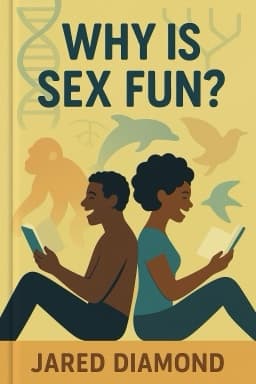
7 Surprising Secrets Evolution Taught Us About Why Sex Is Fun (And Weird)
Unraveling the Evolutionary Mysteries Behind Human Sexuality

Unraveling the Evolutionary Mysteries Behind Human Sexuality
Have you ever wondered why humans—unlike almost every other animal—have sex for fun? Or why we do it in private, why women go through menopause, or why our bodies are covered with signals like beards, breasts, and curves? Jared Diamond’s classic, 'Why Is Sex Fun?' dives into these questions, and the answers are more surprising than you might think. Let’s take a deep, story-rich journey through the evolutionary science that makes our sex lives so unique—and so essential to our humanity.
1. Concealed Ovulation: The Hidden Calendar
Unlike most mammals, human females don’t advertise when they’re fertile. There are no obvious signs—no swelling, no scent, no behavioral cues. This evolutionary trick means that men (and women themselves) can’t tell when conception is possible. Why would evolution favor such secrecy? One theory is that it promotes long-term pair bonding: if a man can’t tell when his partner is fertile, he’s more likely to stick around, strengthening the partnership and helping raise the children. Concealed ovulation may also discourage infanticide by making paternity uncertain, a strategy seen in some primates.
2. Sex for Fun: More Than Just Reproduction
Most animals mate only when conception is possible. Humans, by contrast, have sex throughout the menstrual cycle, during pregnancy, and even after menopause. This isn’t just about pleasure—though that’s a big part of it—it’s about reinforcing bonds, building trust, and ensuring the survival of our helpless, slow-maturing offspring. Frequent sex strengthens emotional connections, making it more likely that both parents will stick together and cooperate.
3. Menopause: The Grandmother Effect
Why do women stop being fertile decades before they die? The 'grandmother hypothesis' suggests that menopause evolved so older women could help raise grandchildren, boosting the survival of their genes. By shifting from producing children to supporting their descendants, grandmothers play a crucial role in human societies—a pattern seen in many traditional cultures.
4. Private Sex: The Need for Intimacy
Unlike most mammals, humans seek privacy for sex. This may have evolved to minimize social conflict or to reinforce pair bonds. Privacy allows intimacy to flourish, transforming sex from a public act into a deeply personal experience.
5. The Battle of the Sexes: Cooperation and Conflict
Diamond describes how evolutionary pressures create both cooperation and competition between men and women. The 'game of chicken' over parental investment—who stays and who leaves—shapes everything from jealousy to the division of labor. Yet, our ability to cooperate, share, and adapt is what sets us apart.
6. Bodies as Billboards: The Art of Attraction
Our bodies are covered in signals—breasts, beards, muscles—that advertise health, fertility, and genetic quality. Some traits, like the peacock’s tail, may have evolved simply because they’re attractive ('runaway selection'). Others, like big muscles, are costly to maintain, signaling strength and good genes ('handicap principle').
7. Culture and Creativity: The Infinite Forms of Love
Human societies have invented countless ways to organize sex, love, and family—from strict monogamy to polygamy, polyandry, and communal living. These systems reflect not just biology, but culture, history, and necessity. What’s normal in one place may be taboo in another, showing our incredible adaptability.
Conclusion: Healing, Wisdom, and Hope
Understanding the evolutionary roots of our sexuality can bring compassion and self-acceptance. We are not prisoners of biology; culture, creativity, and empathy allow us to shape new forms of love and partnership. By embracing our story, we find hope for a more understanding and inclusive future.
For more, check out the book itself and recent research in evolutionary biology.
Sources: Why Is Sex Fun? by Jared Diamond, LA Times Book Review, ExamplesOf.com, and latest evolutionary psychology studies.
Want to explore more insights from this book?
Read the full book summary