
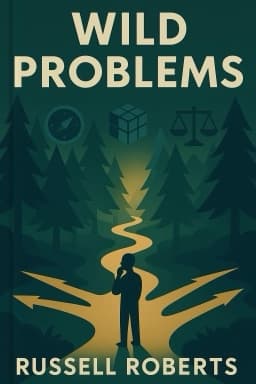
Why Embracing Life’s Wild Problems Will Change Your Future Forever
Discover how tackling life’s most complex decisions with courage and humility transforms your journey.

Every day, we face decisions that seem straightforward: what to eat, which route to take, how to fix a broken appliance. These are tame problems—solvable with clear rules and measurable outcomes. But what about the big questions? Choosing a life partner, deciding on a career path, or committing to a family? These are wild problems, complex and unpredictable, without a formula or a guaranteed answer.
Wild problems resist the tools of data and logic because they involve subjective goals and unknown futures. You cannot measure love or quantify the essence of purpose. Trying to do so is like searching for lost keys only under the streetlight because that's where the light is—ignoring the vast darkness where the keys might truly be.
Understanding this distinction frees us from the illusion that life’s biggest choices can be perfectly calculated. Instead, we learn to live with uncertainty, embracing it as an essential part of the human experience. Courage becomes our ally, humility our guide.
Flourishing, a concept deeper than mere happiness, invites us to seek meaning and identity beyond fleeting pleasures. People willingly endure pain and hardship when it serves a higher purpose—raising children, pursuing a calling, or growing spiritually. This paradox teaches that suffering can enrich life rather than diminish it.
Yet, imagining the future remains fraught with limits. The 'vampire problem' illustrates how our preferences and identity shift after major decisions, making it impossible to fully predict how we will feel. This permanent uncertainty requires us to hold decisions lightly, remain flexible, and cultivate principles that anchor us amidst change.
Integrity serves as a moral compass. Acts like returning a lost diamond earring despite personal cost exemplify choosing who we want to be over immediate gain. Such principled actions preserve self-respect and identity, transcending narrow cost-benefit calculations.
We also learn to get over ourselves, shifting from the main character to an ensemble mindset. Life is richer and more meaningful when we see others as partners in a shared journey rather than mere supporting cast. This perspective fosters empathy, cooperation, and deeper connection.
Keeping options open—optionality—and experimenting with different paths reduce the fear of failure and let us adapt as we learn. Like a coach drafting many players and cutting those who don’t fit, life benefits from flexibility and real-world feedback.
Living like an artist, we treat life as a fluid creation, balancing planning with openness to surprise. Our goals emerge alongside experience, inviting us to savor the process as much as the outcome.
Finally, cultivating self-awareness and humility reveals our habitual patterns and softens ego’s grip, enriching relationships and community. This inner work prepares us to face life’s wild problems with empathy and integrity.
In embracing uncertainty with purpose, we discover that a life well lived is not about certainty but about courage, curiosity, and continuous creation. The journey is unpredictable but deeply meaningful, inviting us to become who we are meant to be.
Embrace your wild problems. Let go of the need for certainty. Choose integrity. Flourish amid uncertainty. Live like an artist. Get over yourself. Keep your options open. Cultivate humility. This is the path to a life transformed.
Want to explore more insights from this book?
Read the full book summary