
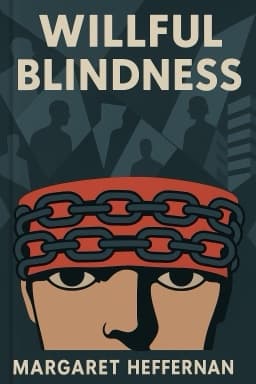
Why We Choose to Ignore the Obvious: The Shocking Truth Behind Willful Blindness
Unlocking the Hidden Forces That Keep Us From Seeing Reality

Imagine walking through a crowded street, yet failing to notice the urgent cries for help nearby. This is not a failure of vision but a failure of attention and willingness—a phenomenon known as willful blindness. It is the act of deliberately ignoring uncomfortable truths or inconvenient facts. But why do we, as individuals and societies, choose to remain blind when the risks of ignorance can be catastrophic?
At the heart of willful blindness lies our deep-seated preference for comfort and familiarity. Humans are wired to seek sameness and avoid conflict, which leads to affinity bias—the tendency to favor people and ideas similar to ourselves. This bias manifests in assortative mating, where people marry those like themselves, and in social clustering, where communities become echo chambers reinforcing shared beliefs. While this creates a comforting sense of belonging, it narrows our perspective and blinds us to alternative viewpoints.
Consider the striking example of orchestras that increased female representation dramatically after adopting blind auditions. Removing visual cues eliminated unconscious gender bias, proving how easily our perceptions can be skewed by irrelevant factors. This example underscores how affinity bias operates beneath conscious awareness, shaping decisions in subtle yet profound ways.
Love, too, blinds us. When we care deeply, our brains suppress critical judgment and magnify virtues, creating positive illusions that sustain relationships but sometimes hide painful realities. Neuroscientific studies reveal that love activates reward centers while dampening areas responsible for negative emotions—explaining why lovers overlook flaws and forgive transgressions. This emotional denial, while protective, can trap us in harmful situations if unchecked.
Beyond personal relationships, deeply held convictions and ideologies act as powerful filters that shape how we interpret evidence. Cognitive dissonance drives us to reject or reinterpret facts that threaten our core beliefs. Historical examples abound—from apocalyptic cults doubling down after failed prophecies to medical communities resisting evidence that prenatal X-rays caused cancer. These illustrate how motivated reasoning preserves identity but perpetuates dangerous blindness.
Our cognitive limitations further compound these effects. The brain’s selective attention means we often miss obvious events when focused elsewhere—a phenomenon known as inattentional blindness. Fatigue and stress impair judgment, increasing tunnel vision and errors. In high-stakes environments, these natural limits can have devastating consequences.
Organizations are not immune; in fact, they often amplify blindness through cultures of silence and conformity. Fear of conflict and retaliation leads employees to withhold concerns, creating dangerous blind spots. Group polarization intensifies shared beliefs, drowning out dissent and reinforcing inertia. Breaking this silence requires courageous leadership and safe channels for honest communication.
So, how do we break free? Courage is the catalyst. Whistleblowers who expose uncomfortable truths, despite personal risk, ignite change and inspire resilience. Cultivating critical thinking and embracing diversity in perspectives further illuminate blind spots. Diverse teams outperform homogenous ones by generating creative solutions and challenging assumptions. Encouraging dissent prevents groupthink and fosters robust decisions.
Ultimately, awareness and honesty empower us to confront reality and act ethically. Collective transparency and dialogue build resilient communities capable of meaningful progress. The journey from willful blindness to clear sight is challenging but essential for personal growth and societal well-being. By choosing to see, we reclaim our power and open the door to a better future.
Unlocking these insights transforms not only how we perceive the world but how we live within it. Let this be an invitation to question, to listen, and to act with courage and compassion.
References: Summary and analysis from Margaret Heffernan’s 'Willful Blindness' and complementary studies on cognitive bias and organizational behavior 1 , 2 , 4 .
Want to explore more insights from this book?
Read the full book summary