
Why Work Isn’t What You Think: Lessons from the Deep History of Labor
How Our Ancient Relationship with Work Still Shapes Our Modern Lives

How Our Ancient Relationship with Work Still Shapes Our Modern Lives
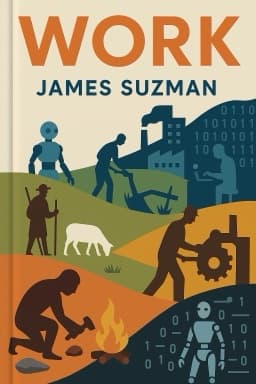
What if everything you thought about work—its origins, its purpose, its necessity—was wrong? James Suzman’s groundbreaking book, Work: A Deep History, from the Stone Age to the Age of Robots, invites us to rethink not only what we do for a living, but why we do it at all. Drawing on anthropology, evolutionary biology, and the latest research in economics, Suzman traces the story of work from the first living cells to the digital revolution, revealing surprising truths that challenge our modern assumptions.
The journey begins with a simple but profound insight: all life, from bacteria to humans, survives by doing work—harnessing energy to create order out of chaos. This act of defying entropy, the universe’s tendency toward disorder, is the universal pulse of existence. For early humans, work was not a grind but a rhythm in tune with nature. Hunter-gatherers, far from living on the brink of starvation, often worked less than 20 hours a week, spending more time on play, storytelling, and community than most people today. Their societies were built on sharing rather than hoarding, cooperation rather than competition.
But the dawn of agriculture changed everything. With the ability to store food came the rise of surplus, and with surplus, the seeds of inequality. Work became more monotonous and demanding, diets worsened, and social hierarchies emerged. The economic problem—how to allocate scarce resources—became central to human life, a mindset that persists even in today’s world of abundance.
The industrial revolution intensified these trends, tying work to identity and social status. Factories demanded long hours, and for the first time, people began to define themselves by their jobs. The anxiety of automation—machines replacing human labor—first appeared in this era and continues to haunt us as AI and robotics transform the workplace once again.
Yet Suzman argues that the real challenge of our age is not how to produce more, but how to share more equitably and use our surplus wisely. As automation offers the possibility of abundance, we must ask new questions: What is the purpose of work when survival is no longer at stake? How can we find meaning beyond productivity? Experiments with shorter workweeks and universal basic income hint at a future where creativity, care, and connection matter more than hours logged or wealth accumulated.
Suzman’s book is not just a history—it’s a call to reimagine what work can be. By learning from our past, we can build a future where work heals, connects, and inspires. The story of work, he reminds us, is the story of who we are—and who we might become.
References: Suzman, J. (2021). Work: A Deep History, from the Stone Age to the Age of Robots. Penguin; Reviews and discussions from Beshara Magazine, Amazon, SoBrief, and Goodreads.
Want to explore more insights from this book?
Read the full book summary