
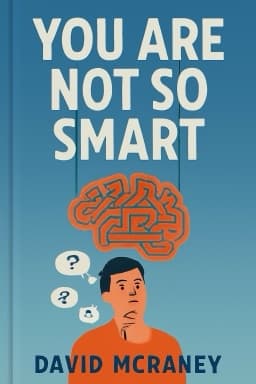
You Are Not So Smart: The Shocking Truth About Your Mind’s Hidden Tricks
Discover how your brain deceives you daily and what you can do to outsmart it.

Have you ever wondered why you sometimes make decisions that seem irrational in hindsight? Or why your memory and beliefs often contradict objective reality? In his groundbreaking book, You Are Not So Smart, David McRaney exposes the many ways our minds deceive us daily, often without our awareness. This blog post unpacks the core ideas of the book, enriched with additional psychological insights and examples to help you understand and eventually outsmart your brain’s hidden tricks.
The Invisible Puppet Master: Unconscious Priming
One of the most fascinating revelations in McRaney's work is how unconscious priming influences behavior. For example, simply being in a room filled with business-related objects like briefcases and fountain pens can unconsciously make people act greedier or more competitive. This happens without any conscious realization, as your mind is subtly nudged by environmental cues. Similarly, the act of washing hands can reduce feelings of guilt due to deep cultural associations linking cleanliness with moral purity. These examples illustrate how much of what we believe is free will is actually shaped by unseen forces operating beneath our awareness.
Weaving Stories: How Your Brain Confabulates
Our brains are master storytellers, constantly filling gaps in memory and understanding with fabricated narratives to maintain a coherent sense of self. This phenomenon, known as confabulation, means that much of what you think you remember or understand about your motivations is constructed after the fact. Studies with split-brain patients show that when one hemisphere cannot explain an action initiated by the other, it invents plausible but false reasons. This insight invites us to approach our memories and self-knowledge with healthy skepticism.
The Comfort of Confirmation Bias
Humans crave consistency and certainty, which leads to confirmation bias—the tendency to seek, interpret, and remember information that supports existing beliefs while ignoring contradictory evidence. This bias is reinforced by selective media consumption and social echo chambers, making it harder to change our minds or consider alternative perspectives. Recognizing confirmation bias is crucial for critical thinking and open-mindedness.
Hindsight Bias: The Illusion of 'I Knew It All Along'
After an event occurs, our minds reconstruct the past to make it seem predictable and inevitable. This hindsight bias inflates confidence and reduces learning from mistakes. People often endorse contradictory proverbs or beliefs, revealing how flexible and malleable memory can be. Awareness of this bias helps foster humility and better decision-making.
The Texas Sharpshooter Fallacy: Seeing Patterns in Randomness
Our brains are wired to seek patterns and meaning, but this can lead to false conclusions, such as seeing meaningful clusters in random data. The Texas Sharpshooter Fallacy describes how we draw a bull’s-eye around random clusters to create a false narrative. Understanding this fallacy helps us appreciate the role of chance and avoid being misled by coincidences.
Procrastination and the Battle Between Present and Future Selves
McRaney explains how present bias causes us to favor immediate rewards over long-term benefits, leading to procrastination. Commitment devices and external accountability can help align behavior with future goals. Recognizing this internal conflict empowers you to design strategies that support self-discipline.
Normalcy Bias: Why We Freeze in Emergencies
In crises, many people experience paralysis due to the normalcy bias, which causes an underestimation of danger and delayed action. Training and preparedness can help override this natural response, improving survival outcomes.
The Limits of Introspection
While introspection is valuable, overanalyzing feelings can disrupt intuitive judgments and lead to fabricated explanations for our behavior. Balancing thoughtful reflection with trust in intuition enhances self-understanding.
Embracing Imperfection: Awareness as Growth
Ultimately, McRaney’s message is hopeful: awareness of our mind’s flaws is the first step toward wiser, more authentic living. By educating ourselves about cognitive biases and practicing mindfulness, we can reduce their impact and live with greater clarity and compassion.
This exploration draws on reviews and analyses from sources such as Medium, Greg Low's blog, and New Book Recommendation to provide a comprehensive understanding of the book’s impact and insights. 1 2 3
Want to explore more insights from this book?
Read the full book summary