
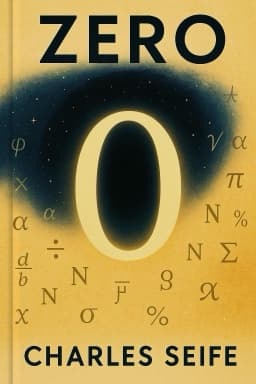
The Infinite Dance: How Zero and Infinity Revolutionized Math and Science
Unveil the profound relationship between zero and infinity and their impact on mathematics, science, and philosophy.

Zero and infinity, seemingly opposite, are in fact intertwined concepts that form the backbone of modern mathematics and science. Their relationship is subtle and profound, challenging human intuition and expanding the horizons of knowledge.
Georg Cantor’s revolutionary work in the late 19th century showed that not all infinities are equal. He demonstrated that the set of rational numbers is countably infinite, while the set of real numbers is uncountably infinite — a larger kind of infinity. This discovery opened new fields in set theory and challenged long-held assumptions.
Projective geometry reveals that zero and infinity are dual concepts. In this framework, parallel lines meet at a point at infinity, and two points determine a line. This elegant symmetry highlights the deep connections between zero and infinity in mathematical structures.
Calculus, developed by Newton and Leibniz, harnessed the power of infinitesimals — quantities approaching zero — and infinite sums to describe motion and change. The introduction of limits provided a rigorous foundation, resolving paradoxes like Zeno’s and enabling the scientific revolution.
Zero and infinity continue to inspire philosophical and scientific inquiry, pushing the boundaries of what we understand about reality, space, time, and existence itself.
Sources: Scientific American, Wikipedia, Diplomacy.edu, Oxford University Press 2 3 1 4
Want to explore more insights from this book?
Read the full book summary