
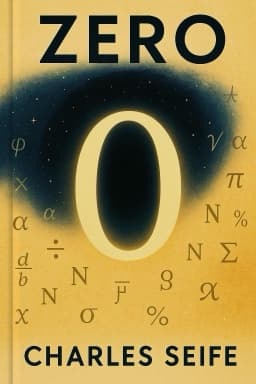
Why Zero Was Feared for Centuries — And How It Changed Everything
Uncover the deep philosophical roots of zero’s rejection and its eventual triumph that transformed human thought.

Zero is a number that embodies paradox. It is the symbol of nothingness yet the foundation of everything. For centuries, it was feared and rejected, especially in the West, because it challenged fundamental philosophical beliefs about existence and the universe.
Greek philosophy, which shaped Western thought for millennia, denied the existence of the void. Aristotle and the Pythagoreans argued that nature abhors a vacuum and that the universe is a finite, ordered whole. Numbers were seen as geometric entities — lengths, areas, volumes — and zero, having no size or shape, did not fit this framework.
Paradoxes like Zeno’s Achilles and the tortoise further complicated matters. Zeno argued that motion was impossible because one must traverse an infinite number of halfway points. These paradoxes exposed the difficulty of reconciling infinite divisibility and motion, concepts closely tied to zero and infinity.
Meanwhile, the Pythagoreans discovered irrational numbers, such as the square root of two, which could not be expressed as ratios of whole numbers. This revelation threatened their belief in a harmonious, rational universe. They kept this knowledge secret, fearing its disruptive implications.
In contrast, Eastern cultures embraced the void. Indian philosophers saw 'sunya' — emptiness — as a profound spiritual and mathematical concept. They gave zero a place on the number line and developed arithmetic and algebra around it. Islamic scholars further propagated zero and Hindu-Arabic numerals during the Middle Ages, preserving and expanding this knowledge.
The Renaissance marked a turning point. Artists used the vanishing point — a zero-dimensional concept — to create realistic perspective, symbolizing infinite space. Philosophers like Nicholas of Cusa proposed an infinite universe, while Copernicus displaced Earth from the center of the cosmos. These ideas challenged Aristotelian dogma and paved the way for modern science.
With the invention of calculus by Newton and Leibniz, zero and infinity became tools to describe motion and change rigorously. Limits formalized the use of infinitesimals, resolving ancient paradoxes and enabling the scientific revolution.
Zero’s philosophical journey from feared void to essential number reflects humanity’s evolving understanding of reality. It teaches us that embracing the unknown and the infinite is key to progress and discovery.
Sources: Scientific American, Diplomacy.edu, Oxford University Press, Wikipedia 2 1 4 3
Want to explore more insights from this book?
Read the full book summary