
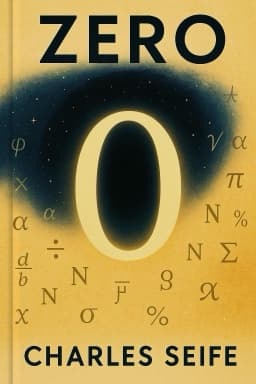
Zero: The Hidden Hero Behind Our Digital Age and Beyond
Discover how the concept of zero revolutionized human thought, science, and technology, shaping the modern world.

Imagine a world without zero. Counting would be cumbersome, calculations tedious, and modern technology unimaginable. Yet, zero’s story began humbly as a simple placeholder — a mark indicating the absence of value in ancient Babylonian numerals. This symbol, born around 300 BC, was not a number but a tool to avoid confusion in positional counting. It was the quiet guardian of clarity in a complex numerical system.
Centuries later, Indian mathematicians elevated zero from a mere placeholder to a number with its own value, calling it 'sunya', meaning empty. This breakthrough allowed the development of algebra, negative numbers, and a more versatile number system. The Indian concept of zero was transmitted through Islamic scholars, who embraced and expanded upon it during the Golden Age of Islam, translating texts and spreading knowledge across continents.
Despite zero’s power, the West resisted it for centuries. Greek philosophers, who saw numbers as geometric shapes, rejected zero because it symbolized nothingness and void, concepts that unsettled their worldview. Paradoxes like Zeno’s Achilles and the tortoise challenged the notion of motion and infinite divisibility. It was only during the Renaissance that zero and infinity began to reshape art, science, and philosophy. Artists used the vanishing point — a zero-dimensional concept — to create realistic perspective, while thinkers like Nicholas of Cusa and Copernicus expanded the cosmic horizon beyond Earth.
The true mathematical power of zero emerged with the invention of calculus by Newton and Leibniz. Calculus harnessed infinitesimals approaching zero and infinite sums to describe motion and change, resolving ancient paradoxes and opening new scientific frontiers. Later, concepts like limits formalized these ideas, making calculus rigorous and indispensable.
In modern mathematics, zero and infinity are twin pillars. Cantor’s work revealed different sizes of infinity, showing that the infinite set of real numbers is larger than that of rational numbers. Projective geometry treats zero and infinity as dual concepts, highlighting a deep symmetry in mathematical structures. Moreover, infinite sets like rational numbers can have zero measure, illustrating the subtlety of infinity.
Zero’s influence extends beyond mathematics into physics and cosmology. The quantum vacuum, far from empty, teems with zero-point energy and virtual particles, revealing zero as a dynamic force. Black holes compress matter to singularities where volume approaches zero and density becomes infinite, challenging classical physics. The big bang itself began from a zero-dimensional point of infinite density, marking the birth of space and time.
Zero’s final victory is evident in the digital age. Binary code, the foundation of all computing, relies on zero and one to encode data and instructions. Without zero, the information revolution would be impossible. Yet zero remains a concept of mystery and power, inspiring ongoing research in mathematics, physics, and cosmology. It challenges us to embrace the infinite and the void, pushing the boundaries of human knowledge.
Zero’s journey from nothingness to everything is a testament to human curiosity and resilience. It reminds us that even the emptiest void can hold infinite possibilities, and that embracing the unknown is the path to discovery.
Explore this incredible journey and see how zero quietly shapes our world, from the stars above to the screens in our hands.
Sources: Diplomacy.edu, Scientific American, Wikipedia, Oxford University Press 1 2 3 4
Want to explore more insights from this book?
Read the full book summary