
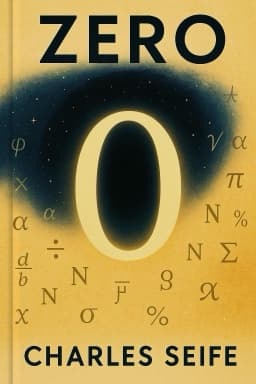
Zero: The Number That Changed Everything — From Ancient Times to Quantum Realities
Trace zero’s incredible journey from ancient counting systems to the heart of quantum physics and computing.

Zero’s origins lie in the ancient world, where early civilizations used tally marks and placeholders to count and record quantities. The Babylonians introduced a symbol to mark empty positions in their base-60 system, but zero was not yet a number. Indian mathematicians transformed zero into a number with its own value, enabling algebra and negative numbers. Islamic scholars preserved and spread this knowledge, leading to its adoption in Europe during the Middle Ages.
Philosophical resistance in the West delayed zero’s acceptance, but the Renaissance and scientific revolution changed everything. Calculus harnessed zero and infinity to describe motion and change, while new cosmological models expanded our understanding of the universe.
In modern physics, zero is central to understanding the quantum vacuum, a seething field of energy and particles. Black holes compress matter to singularities of zero volume and infinite density, while the big bang began from a zero-dimensional point. These phenomena reveal zero as a dynamic and mysterious force shaping reality.
Zero’s impact extends to technology, where binary code relies on zero and one to encode all digital information. This foundation powers computers, communication, and the digital age, making zero a silent hero of modern life.
Zero’s journey from nothingness to everything is a testament to human ingenuity and curiosity. It reminds us that even the void holds infinite possibilities and that embracing the unknown leads to discovery.
Sources: Diplomacy.edu, Scientific American, Wikipedia, Oxford University Press 1 2 3 4
Want to explore more insights from this book?
Read the full book summary