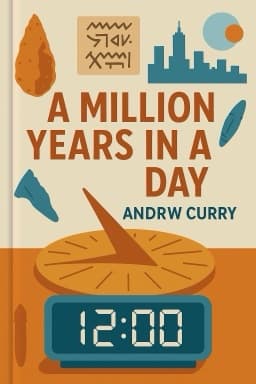
Andrew Curry
A fascinating journey through the deep history of daily human routines and their cultural evolution.
The earliest known calendar is a 30,000-year-old eagle bone with lunar notches.
7 more facts available in the app
Section 1
10 Sections
Imagine a world without clocks, calendars, or any mechanical device that ticks away relentlessly, commanding our routines and shaping our lives. For most of human history, time was not measured by gears or digital displays but by the very rhythms of the cosmos—the waxing and waning of the moon, the steady arc of the sun across the sky, and the nightly parade of stars.
As civilizations blossomed, so too did our methods of timekeeping. The Egyptians, for example, developed star charts known as Decans—36 constellations that rose heliacally, marking ten-day periods throughout the year. By tracking these stars, priests could tell the hour of the night, a celestial clock etched onto tomb walls and sarcophagi.
Daylight hours were tracked using sundials and shadow clocks, simple yet ingenious tools that harnessed the sun’s movement. The Romans, inheriting and adapting Greek innovations, installed sundials across their empire, though not without issues—one sundial brought from Sicily to Rome was misaligned due to latitude differences and thus inaccurate until corrected decades later.
Timekeeping was not just a scientific pursuit but a cultural one, deeply intertwined with religion, governance, and daily life. Different societies started their days at dawn, dusk, or midnight, reflecting their beliefs and practical needs. The French Revolutionaries, driven by Enlightenment ideals, attempted to decimalize time—dividing the day into ten hours, each with 100 minutes and seconds.
Fast forward to the 19th century, the explosion of railways and telegraphy demanded standardized time zones and synchronization, leading to the adoption of Greenwich Mean Time and the eventual creation of Daylight Saving Time. These innovations transformed time from a local, flexible concept into a rigid, global framework that governs modern life.
Our relationship with time is a dance between nature’s rhythms and human invention—between the ancient skywatchers and the engineers of atomic clocks.
What natural phenomena did early humans use to measure time?
19 more quizzes available in app
Humans have always relied on natural phenomena like the sun, moon, and stars to measure time before mechanical devices existed.
8 more insights available in app
Unlock all 10 sections, 9 insights, full audio, and interactive mind map in the SnapBooks app.