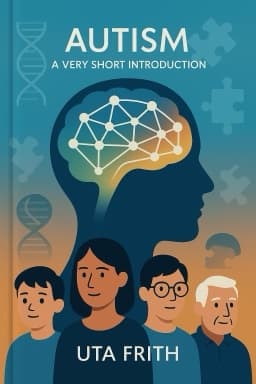
Uta Frith
A concise and accessible overview of autism spectrum disorders, exploring their nature, causes, cognitive theories, and practical implications.
Autism was first described as a distinct condition in the early 1940s by Leo Kanner and Hans Asperger independently.
2 more facts available in the app
Section 1
6 Sections
Imagine stepping into a world where each mind dances to its own rhythm, where the familiar cues of social connection are muted or transformed. Autism, as we now understand, is not a single fixed state but a vast spectrum of experiences and abilities.
Consider David, a boy who learned to read independently at an early age, yet struggled to understand the meaning behind the words. His love for bouncing on a trampoline and lining up toys day after day reveals the intense focus and repetition common in autism. In contrast, Edward, diagnosed with Asperger syndrome, dazzles with his vocabulary and scientific interests, yet finds social chit-chat a puzzle. These stories remind us that autism is not a monolith but a kaleidoscope of human difference.
Early signs, such as the lack of joint attention—the ability to share focus on an object with another person—often emerge in the toddler years. This subtle behavior is a window into the complex social world that autistic children navigate differently. Some may regress after initial typical development, losing language or social engagement, which can be heartbreaking for families. Others may develop more slowly, with social interests blossoming later.
The journey to diagnosis is often fraught with ambiguity and waiting. But understanding the spectrum allows us to appreciate each individual's unique path.
What are the core features that unify the autism spectrum?
11 more quizzes available in app
Autism is not a single condition but a spectrum with varied presentations.
7 more insights available in app
Unlock all 6 sections, 8 insights, full audio, and interactive mind map in the SnapBooks app.
A comprehensive deep dive into the diverse world of autism, its history, brain science, and effective support strategies.
Read articleExplore the extraordinary cognitive styles and talents that make autism a source of unique brilliance.
Read article