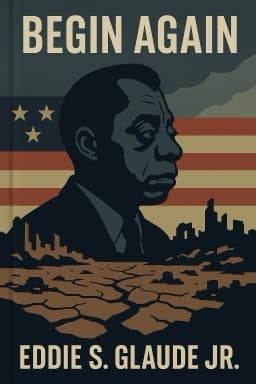
Eddie S. Glaude Jr.
A profound reflection on James Baldwin’s legacy and America’s racial reckoning, urging truth-telling and renewal.
James Baldwin was a prolific writer and activist whose works deeply influenced the civil rights movement.
Section 1
9 Sections
As we embark on this journey through the profound reflections of America's racial history, we begin by confronting a foundational truth: the existence of a pervasive and powerful lie. This lie, woven into the very fabric of the nation, is not a mere untruth but an extensive architecture of falsehoods that sustain the racial value gap—where white lives have been deemed more valuable than black lives.
From the earliest days of the republic, the lie took shape as the denial of black humanity, a necessary fiction to justify the institution of slavery. This denial was not confined to isolated beliefs but codified into laws, cultural norms, and social practices that have endured for centuries. It created a reality where the color of one's skin dictated the worth of one's life, embedding itself so deeply that it became invisible to many—breathing like air into the American identity.
Consider how history is often told: slavery is described as a regrettable mistake, segregation as a bygone era, and the civil rights movement as a triumphant conclusion to racial injustice. Yet, beneath these narratives lies a persistent refusal to face the full truth of systemic oppression. This distortion allows the nation to preserve a self-image of virtue while the wounds of inequality fester beneath the surface.
Within this context, the lie operates as a shield for white identity, protecting it from the destabilizing truth of complicity and privilege. It is a collective evasion that refuses to acknowledge the moral cost of maintaining racial hierarchies. The consequences are profound—not only for those oppressed but also for those who wield power unwittingly or deliberately, trapped in a system that dehumanizes all involved.
Yet, recognizing the lie is the first step toward dismantling it. It requires courage to unveil the myths and face the uncomfortable realities of history and present-day society. The lie's power lies in its invisibility and acceptance; thus, the act of naming it disrupts the status quo and opens a pathway for transformation.
As we move forward, we will explore how bearing witness to this truth becomes a moral imperative for those who seek justice and healing. The journey is arduous, marked by trauma and disillusionment, but also by resilience and hope. The lie may be deeply entrenched, but so too is the human capacity for change and renewal.
With this understanding as our foundation, let us now turn to the role of witness—the act of seeing and speaking the truth amidst darkness—and how it shapes the struggle for a new beginning.
What is the 'lie' referred to in the context of America's racial history?
17 more quizzes available in app
The lie is not just a falsehood but a systemic structure that sustains racial hierarchy and white supremacy.
7 more insights available in app
Unlock all 9 sections, 8 insights, full audio, and interactive mind map in the SnapBooks app.
Dive deep into the systemic falsehoods shaping America’s racial divide and discover a path toward truth and healing.
Read articleThe uncomfortable truths we avoid—and how confronting them can spark real change.
Read article