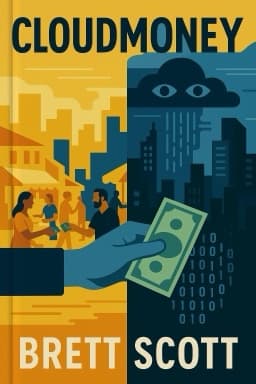
Brett Scott
A critical investigation into the rise of digital money and the battle for control over our financial lives.
Brett Scott is a former derivatives broker who became a financial activist and writer.
Section 1
9 Sections
Let’s begin our journey with a gentle breath, imagining the world as it was just a few decades ago—where coins clinked in pockets and notes passed from hand to hand, weaving a tapestry of trust and exchange. But now, the air above our wallets has thickened with something new: a digital mist, a cloud that carries our money far from our fingers and into the unseen vaults of data centers.
Across the globe, this transformation is visible in the smallest gestures. In a bustling city, a street vendor once counted change for a customer—now, the same transaction is a tap, a beep, a silent approval from a distant server. In the wake of the pandemic, these changes accelerated. Cafés and airlines, citing safety, began to refuse cash. Even vending machines, once simple and mechanical, now blink expectantly for cards or phones.
Yet, beneath this digital surge, the story is more nuanced. Central bankers quietly report that the demand for cash has not vanished; in fact, it has risen in many places, especially when uncertainty looms. When storms threaten or economies wobble, people instinctively seek the comfort of something tangible—a banknote, a coin, a physical promise that cannot be erased by a power outage or a software glitch.
But the narrative we hear is different. Advertisements on subway walls and billboards in city centers proclaim, 'The Future is Here,' urging us to embrace the cashless society as a mark of progress. Politicians echo these mantras, and tech giants unveil ever more seamless ways to pay.
As we breathe in this new air, it’s easy to forget that money is not just a tool—it’s a relationship, a social contract that connects us to one another and to the world around us. The shift to cloudmoney is not just technical, but deeply human. It asks us to trust in distant systems, to let go of the familiar weight of cash, and to accept a new form of dependency.
This section sets the stage for our exploration. The world is changing, but the story is not as simple as it seems. As we move forward, we’ll look beneath the surface and question the forces shaping this transition. What do we gain, and what might we lose, as money becomes ever more ethereal? Let’s step together into the next chapter, where we’ll explore the hidden engines driving the automation of finance.
What is the main theme of the transformation described in this section?
17 more quizzes available in app
The rise of digital money systems controlled by distant data centers and corporations.
7 more insights available in app
Unlock all 9 sections, 8 insights, full audio, and interactive mind map in the SnapBooks app.