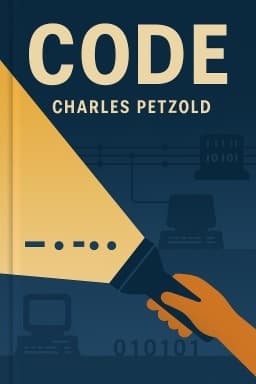
Charles Petzold
A fascinating journey from codes and circuits to the inner workings of computers.
Charles Petzold originally conceived 'Code' as a book without metaphors—eschewing the usual trains and cargo analogies for pure logic and history.
Section 1
6 Sections
Let’s begin our gentle journey into the world of hidden languages—the codes that shape every moment of communication, whether you’re whispering secrets to a friend or sending texts across the globe. Imagine two children, windows facing each other, flashlights in hand. The night is quiet, but in the darkness, a secret conversation blinks between rooms. Each flash, a letter; each pause, a space. This is Morse code, a language of light and timing, born from the need to connect when voices can’t carry.
But Morse code is only one thread in the vast tapestry of codes. Think about Braille, where each letter is a pattern of raised dots, felt rather than seen. Six dots, each either up or down, create a world of meaning for those who read with their fingers. It’s a quiet, tactile code—binary at heart, just like the on-off switches that power every computer.
We use codes to make life easier, to speed up communication, to keep secrets, or to simply be understood. The spoken word, the written word, sign language, shorthand—each is a code, a way to turn thoughts and feelings into something that can be shared. And just as Morse code is more efficient than blinking the alphabet one letter at a time, all great codes are designed to serve a purpose, whether it’s speed, secrecy, or clarity.
As you listen, remember:
Why does Morse code use shorter codes for common letters?
11 more quizzes available in app
Codes are the foundation of all communication, bridging the gap between people and machines.
7 more insights available in app
Unlock all 6 sections, 8 insights, full audio, and interactive mind map in the SnapBooks app.
Unlocking the Hidden Language of the Digital World, One Blink at a Time
Read articleWhy Every Switch You Flip Is a Tiny Act of Programming
Read article