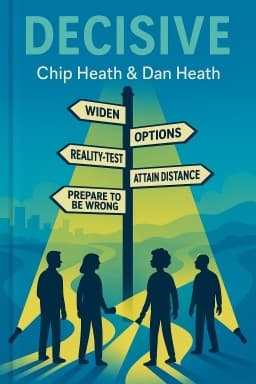
Chip Heath & Dan Heath
A science-backed framework for making better decisions in business and life.
The WRAP process was inspired by years of research into both business and personal decision-making failures.
Section 1
6 Sections
Let me invite you to settle in, take a deep breath, and join me on a gentle exploration of the mysterious forces that shape every choice we make. Imagine, for a moment, the last time you had to make a big decision—maybe about work, love, or a path forward in life. Did you feel confident, or did you sense an invisible tug-of-war inside your mind?
First, there’s narrow framing, that subtle habit of seeing choices as either/or, missing out on the world of possibilities just outside the spotlight. It’s like standing at a fork in the road and forgetting you could also climb a tree, build a bridge, or simply rest for a while. Then comes confirmation bias, that comforting warmth of information that agrees with us, encouraging us to seek only what supports our beliefs. We all crave reassurance, but sometimes, it’s the gentle challenge to our thinking that leads us to wisdom.
The third villain, short-term emotion, is like a storm that clouds our vision, making it hard to see beyond the moment’s turbulence. We may know, deep down, that our feelings will pass, but in the heat of decision, they can feel all-consuming. And finally, there’s overconfidence, the quiet voice that assures us we can predict the future, even when the world is full of surprises.
What’s remarkable is that these villains are universal. They shape the choices of business leaders, parents, students, and artists alike. The research is clear: even the most analytical minds are not immune. In fact, studies show that teams with a thoughtful, inclusive process—one that surfaces doubts and welcomes dissent—make decisions that are six times more effective than those relying on analysis alone.
But what about the classic pros-and-cons list? It’s tempting to believe that careful weighing of positives and negatives is enough. Yet this method, dating back to Benjamin Franklin’s 'moral algebra,' is surprisingly vulnerable to bias. Our brains are too good at stacking the deck, favoring what we already want to believe, and missing what’s just out of view.
So, as we begin this journey, remember:
Which of the following is NOT one of the 'four villains' of decision making?
11 more quizzes available in app
Narrow framing, confirmation bias, short-term emotion, and overconfidence are the main obstacles to good decisions.
7 more insights available in app
Unlock all 6 sections, 8 insights, full audio, and interactive mind map in the SnapBooks app.
Discover the hidden traps in your thinking and the science-backed strategies to outsmart them.
Read articleHow developing several options at once can supercharge your results at work and in life.
Read article