William Wresch
A critical examination of global information inequality, barriers to access, and the human and societal challenges in the Information Age.
The concept of an information glut was first recorded in 1789 with complaints about legal publications.
2 more facts available in the app
Section 1
9 Sections
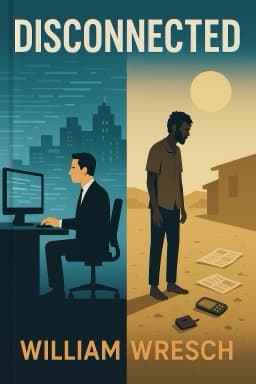
Imagine two men living in the same city, yet occupying entirely different worlds. One rises early to wash his BMW, surrounded by the hum of computers and the steady flow of emails from Europe and America. He reads thousands of business articles, travels internationally, and connects daily with global partners. This man is the embodiment of the information-rich, thriving in the digital age with access to the latest knowledge and networks.
Across town, another man wakes before dawn, not to embrace opportunity, but to endure another day of waiting. He stands on a dusty street corner, hoping for a day's labor that will barely feed him. His world is silent—no newspapers, no TV, no internet. His only news is rumors whispered among others equally desperate.
This stark contrast is not just a tale of two individuals but a metaphor for a global reality. Even as we celebrate an explosion of information, vast populations remain isolated. Technology alone does not guarantee access. The presence of computers and satellites in a city does not mean everyone benefits. Social structures, language barriers, poverty, and exclusion shape who hears the news and who remains in darkness.
Consider the economic realities: a newspaper may cost a tenth of a day’s wage for one man, making it unaffordable for another. Television broadcasts in a language unknown to many in the community become irrelevant. The networks that deliver information often serve only a privileged few, leaving others stranded.
Yet, this divide is not immutable. Recognizing the problem is the first step toward bridging it. Understanding that information is not neutral but shaped by creators, controlled by gatekeepers, and filtered by social networks allows us to see where interventions are needed.
As we move forward in this journey, we must explore the sources of information more deeply, to understand not just what is available, but who controls it and how it reaches—or fails to reach—the people who need it most. The story of these two men is just the beginning.
Let us now delve into the origins of information itself, to see how the content and channels shape what we know and who gets to know it.
What main factor separates Theo Schoeman and Negumbo Johannes in their access to information?
17 more quizzes available in app
Information access is not evenly distributed; wealth and social status create vast divides.
8 more insights available in app
Unlock all 9 sections, 9 insights, full audio, and interactive mind map in the SnapBooks app.