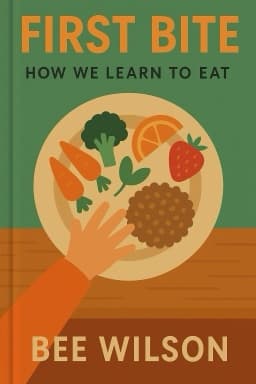
Bee Wilson
An exploration of how eating habits are learned, shaped by memory and environment, and how they can be changed to promote healthier, more pleasurable diets.
Human babies have an innate preference for sweetness and dislike bitterness, but their actual food preferences are learned.
2 more facts available in the app
Section 1
6 Sections
Imagine a young child seated at a family table, faced with a plate of vibrant vegetables that she eyes with suspicion. This hesitation, this reluctance to embrace the unfamiliar, is not simply a quirk of personality but a window into the intricate dance between biology and environment that shapes our tastes.
Take, for example, the phenomenon of PROP supertasters—individuals who perceive bitterness more intensely due to genetic variations. One might assume that such heightened sensitivity would doom these individuals to a lifetime of rejecting bitter vegetables like Brussels sprouts or kale. However, research reveals a more nuanced reality. While supertasters do experience flavors more acutely, their actual food choices depend heavily on their environment and experiences.
Social modeling plays a profound role in shaping what we eat. Children, in particular, are keen observers and imitators. Studies show that when children eat in groups, their food choices tend to align with their peers, demonstrating a powerful social influence. Imagine a shy child glancing furtively at an older, confident peer before deciding to try a new food. This simple act of imitation is a cornerstone in the development of taste.
Yet, this journey is not without its hurdles. Neophobia, the fear of new foods, peaks between ages two and six, serving as an evolutionary safeguard against potential toxins but posing a challenge in modern diets rich in diverse, healthy options. Overcoming this fear requires patience and strategy—repeated gentle exposure, positive reinforcement, and sometimes a playful approach, like introducing a favorite doll that 'eats' the new vegetable with delight.
The story of Clara Davis’s pioneering experiment in the 1920s offers a striking illustration of the power of environment. Children placed in a controlled setting with only wholesome, unprocessed foods to choose from naturally balanced their diets, regardless of individual quirks.
As we reflect on these insights, it becomes clear that our food likes and dislikes are not immutable traits but evolving narratives shaped by exposure, social context, and memory. This understanding opens the door to change, to the possibility that even the most stubborn aversions can soften with time and care.
With this foundation laid, we now turn to the profound role of memory in the flavors that move us, the tastes that comfort and define us across a lifetime.
What primarily shapes our food likes and dislikes?
11 more quizzes available in app
Food preferences are not fixed at birth but develop through exposure and social influence.
7 more insights available in app
Unlock all 6 sections, 8 insights, full audio, and interactive mind map in the SnapBooks app.
Discover the fascinating interplay of biology, memory, and culture that shapes your food choices and how you can transform them for good.
Read articleExplore the surprising ways your earliest food experiences influence what you crave today and how parents can nurture adventurous eaters.
Read article
Michael F. Roizen, M.D. and Michael Crupain, M.D., M.P.H.
Sara Gottfried, MD
Molly Carmel
David Perlmutter, MD
