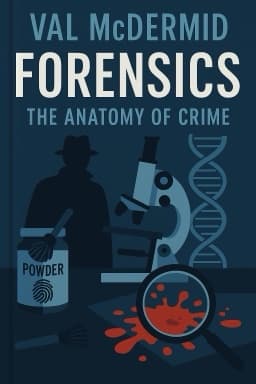
Val McDermid
A detailed journey through the history, methods, and impact of forensic science in solving crimes and delivering justice.
Edmond Locard, the father of forensic science, famously said, 'Every contact leaves a trace,' which remains a foundational principle today.
2 more facts available in the app
Section 1
8 Sections
Imagine a quiet street suddenly shattered by violence. The scene becomes a silent witness to events that words cannot capture. This is where the journey of forensic science begins, with the crime scene investigator stepping into a world where every footprint, fiber, and bloodstain tells a story.
In a high-profile case where two policewomen were shot on duty, the investigators faced not only the technical challenge of preserving evidence in an outdoor environment but also the emotional toll of working amidst colleagues’ grief. They wore double gloves, masks, and protective suits not for show but to ensure their own presence did not contaminate the delicate traces left behind.
Photographs captured every angle, from ceiling to floor, allowing later virtual reconstructions that let juries walk through the scene as if they were present. The crime was not confined to one spot; the getaway vehicle, the path the suspects took, and even the locations of arrest became interconnected scenes, each adding pieces to the puzzle. The evidence found ranged from blood spatter to bullet casings, each analyzed with precision to link the suspects to the crime.
Yet the unseen battle is against contamination and loss. Weather, passerby traffic, and even the investigators themselves threaten to erase or alter the silent testimony of the scene. The use of stepping plates, careful documentation, and rapid response teams underscores the urgency and delicacy of the work.
But beyond the technicalities lies a human story — of investigators who, despite exhaustion and emotional strain, pursue truth with unwavering dedication. They know that their work can bring justice, closure, and peace to families shattered by violence. This balance of science and humanity shapes the foundation of forensic inquiry.
As we leave the silent witness behind, we turn to another devastating force of nature and human tragedy — fire — where destruction often obscures the truth, but science offers a way to illuminate it.
What does the Locard Exchange Principle state?
15 more quizzes available in app
The crime scene holds all the clues needed to reconstruct events, even when witnesses or victims cannot speak.
8 more insights available in app
Unlock all 8 sections, 9 insights, full audio, and interactive mind map in the SnapBooks app.
Discover the meticulous art of crime scene investigation that transforms silent evidence into powerful testimony.
Read articleHow forensic experts decode the destructive language of fire to uncover truth and prevent future tragedies.
Read article