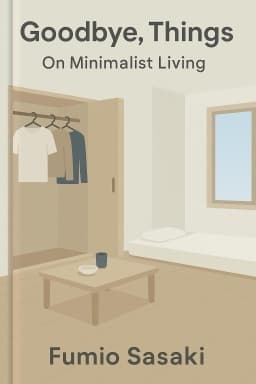
Fumio Sasaki
A transformative guide to minimalist living that blends practical tips with deep insights on happiness, freedom, and personal growth.
Fumio Sasaki once owned over 1,000 items and reduced them to about 5% of that number.
2 more facts available in the app
Section 1
7 Sections
Imagine the moment of your arrival into this world. You come with nothing — no possessions, no clutter, no distractions. This is the purest form of minimalism, the state in which every human begins life.
Consider the traditional Japanese way of life, where minimalism was not a lifestyle choice but a natural way of living. The tea ceremony, with its tiny entrance and simple decor, reminds us that value lies not in excess but in appreciation of the essentials.
In modern times, minimalism has resurfaced as a response to overwhelming information and possessions. The rise of smartphones, the constant influx of news, and the pressure to own more have created a world where our brains, unchanged for thousands of years, struggle to keep up.
Think of the contrast between the messy apartment filled with books, gadgets, and clothes never worn, and the serene space where only what is truly needed remains. The former represents a life controlled by possessions; the latter, a life where possessions serve us, not the other way around. The journey from maximalism to minimalism is not just about throwing things away, but about reclaiming control over your time, your energy, and your happiness.
As we embark on this journey, remember that minimalism is not about deprivation but liberation. It is a gentle unfolding back to our natural state, where less truly becomes more.
Let this understanding be the foundation as we explore why we accumulate so much and how we can begin to let go.
What is the original state of human possession at birth?
13 more quizzes available in app
Minimalism is not a new trend but a return to our original, unburdened state.
8 more insights available in app
Unlock all 7 sections, 9 insights, full audio, and interactive mind map in the SnapBooks app.
Discover the profound power of living with less and how it can bring you happiness, health, and time.
Read articleExplore the deep connection between minimalism and lasting happiness backed by science and philosophy.
Read article
Dr Julie Smith
Adam Alter
Haemin Sunim
Bill Burnett and Dave Evans
