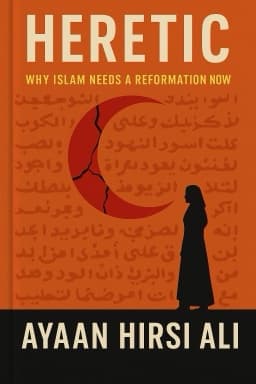
Ayaan Hirsi Ali
Ayaan Hirsi Ali’s 'Heretic' calls for a Muslim Reformation by critically examining Islam’s core doctrines and advocating for reform to align with modern values and human rights.
Ayaan Hirsi Ali was once a member of the Dutch Parliament before becoming an author and activist.
Section 1
7 Sections
The journey into understanding the challenges of Islam begins with its roots: a faith that is not merely spiritual but deeply political, shaped by the life of a man who was both prophet and tribal leader. Imagine a rugged desert landscape where tribes, fractious and often at odds, found unity under a single banner. This man, whose life intertwined spiritual revelation with political conquest, crafted a 'supertribe' that transcended kinship and tribal rivalries. His name is synonymous with both religious guidance and military leadership, a duality that sets Islam apart from other monotheistic traditions.
This fusion of faith and power created a social order that was as much about governance and law as it was about worship and spirituality.
At the heart of this order is the Qur’an, regarded by believers as the perfect, unaltered word of God. Yet, when we delve into its history, we find a text that was compiled over decades, with early manuscripts revealing variations and editorial decisions. This complexity challenges the notion of a single, immutable scripture and opens the door to critical reflection and interpretation.
The Qur’an’s sacredness is intertwined with the reverence for the Prophet himself, whose life and actions are held as a model for all time. This reverence creates a powerful resistance to questioning and reform, as any challenge is seen as an affront to the faith’s very foundation.
Adding another layer to this intricate tapestry is the tribal culture of honor and shame, deeply embedded within Islamic teachings. The kinship bonds, the pride in lineage, and the imperative to uphold family honor shape social behavior and community expectations. Dissent or apostasy is not merely a personal choice but a betrayal of the collective, punishable by severe sanctions.
Understanding these intertwined elements—the man, the book, and the culture—is crucial to grasping why Islam today faces such profound challenges in reconciling its past with the demands of modernity.
As we move forward, we will explore how these foundations influence the faith’s focus on the afterlife and the consequences this has for the world we live in.
What dual role did Muhammad play in early Islamic society?
13 more quizzes available in app
Understanding Muhammad’s dual role is essential to grasp Islam’s intertwined religious and political nature.
7 more insights available in app
Unlock all 7 sections, 8 insights, full audio, and interactive mind map in the SnapBooks app.
Exploring the complex roots of Islam and why reform is urgent for peace and progress
Read articleA deep dive into Islam’s origins, legal systems, and the forces shaping its modern crises
Read article