Imagine you are sitting in a warm living room, the world outside in turmoil from a recent storm. The news flickers with stories of families paying ten dollars for a bag of ice, of neighbors struggling to find shelter, and of a community divided over what is fair. In this gentle space, we begin our journey into the world of justice—a journey that is as close as your next conversation, as real as the choices you make at the grocery store, and as profound as the headlines you read each morning.
Justice, you see, is not just the domain of judges and lawyers. It is the quiet force that shapes our relationships, our communities, and even our sense of self. It is present in the outrage we feel when someone profits from disaster, in the pride we take in honoring sacrifice, and in the discomfort we sense when rewards go to those who seem undeserving. Every time we ask, 'Is this fair?' or 'Should this be allowed?' we are engaging in the ancient, ongoing work of justice.
Consider the story of a hurricane that left a city without power. Ice, once a simple luxury, became a lifeline—its price soaring, tempers flaring, and the line between need and greed blurring. Some argued that high prices were simply the market at work, rewarding those who could supply what was needed. Others saw exploitation, a moral failing that demanded intervention. The law, too, was caught in the middle, as lawsuits and penalties followed the storm.
But justice is not only about economics. It is also about honor and recognition. When soldiers returned home, some wounded in body, others in mind, the question arose: Who deserves a medal? Is sacrifice only counted in blood, or do invisible wounds matter, too? The debate over military honors revealed how deeply our sense of justice is intertwined with our values and our vision of what is noble.
And then there are the great dramas of our time—the financial crises, the bailouts, the headlines that make us ask: Why do some reap rewards while others bear the cost? When executives received bonuses after their companies were rescued by public funds, a wave of anger swept the nation. It was not just about money—it was about who deserves what, and why.
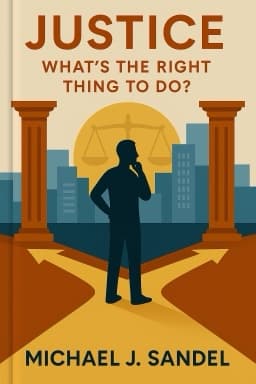
In each of these cases, we see the three great pillars of justice: the desire to maximize welfare (so that society as a whole prospers), the need to respect freedom (so that individuals can choose their own path), and the call to promote virtue (so that we reward what is truly good). These pillars are not just abstract ideas—they are the threads that weave through every debate, every law, and every act of citizenship.
Justice, then, is not merely a set of rules. It is a living conversation, a search for meaning that requires us to look inward and outward, to listen as much as to speak, and to balance our own needs with those of others. This conversation is as relevant in the halls of government as it is in the quiet moments of our daily lives.
As we close this first chapter of our story, let us remember that the search for justice is not a burden, but a gift—a chance to shape the world with compassion, wisdom, and hope. In the next section, we will journey deeper, exploring how our moral reasoning helps us navigate the most difficult choices, and how philosophy can be a light in the darkness of uncertainty.