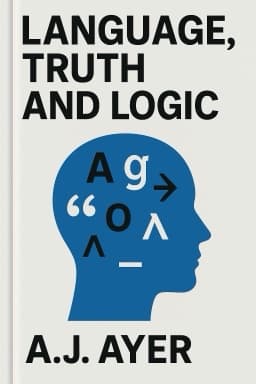
A.J. Ayer
A rigorous defense of logical positivism, advocating the verification principle and rejecting metaphysics as meaningless.
A.J. Ayer was a leading figure in the logical positivist movement in the mid-20th century.
1 more facts available in the app
Section 1
9 Sections
Imagine standing at the edge of a vast ocean of words, ideas, and philosophies that have accumulated over millennia. Among these, some waves shimmer with clarity, reflecting the light of reason and observation, while others crash noisily, obscured by fog and confusion. This is the realm where metaphysics traditionally dwelled — a realm of lofty claims about realities beyond what we can experience. But what if much of this realm is a mirage? What if these grand statements, often uttered with conviction, are actually devoid of literal meaning?
Consider the claim that there exists a reality beyond all possible experience — a so-called 'Absolute' that evolves yet remains unchanged. What observations could possibly verify such a statement? None. It is not merely difficult to test; it is logically impossible to conceive of any experience that would confirm or deny its truth. Hence, by the verification principle, such a claim is literally meaningless, a pseudo-proposition that masquerades as profound insight but is in fact empty.
Yet this does not mean that all abstract or speculative language is nonsense. Some statements are tautologies — true by virtue of their logical form, like 'All bachelors are unmarried.' Others are empirical hypotheses, like 'There are mountains on the far side of the moon,' which, though currently unverified, could be tested in principle. The verification principle distinguishes these meaningful statements from metaphysical nonsense.
This realization leads us to a profound conclusion: much of traditional metaphysics, with its talk of substances, essences, and transcendent realities, is not genuine knowledge but linguistic confusion. For example, the term 'substance' often arises from the assumption that every word must correspond to a real entity, but this assumption misleads us. What really matters is not some hidden entity but the network of relations among observable properties.
Similarly, the notion of 'being' as an attribute is a fallacy. Saying 'Martyrs exist' is not attributing existence as a property but affirming that certain sensations or experiences occur. To treat existence as an attribute leads to contradictions and nonsensical claims about fictitious objects like unicorns having a special mode of being.
Philosophy, then, must free itself from these errors and focus on statements that are either analytic or empirically verifiable. Metaphysics is thus eliminated as a source of genuine knowledge, and its utterances are recognized as nonsensical, whether arising from error or mystical expression.
Far from being a defeat, this elimination is a liberation. It clears the ground for philosophy to become a rigorous, critical enterprise focused on clarifying language and concepts — a discipline that helps us understand what can be meaningfully said about the world.
As we move forward, we will see how this foundation shapes the function of philosophy itself, transforming it from a speculative quest for first principles into a precise analytic practice. Let us now journey beyond the elimination of metaphysics and explore what philosophy truly is.
What criterion determines if a sentence is factually significant?
17 more quizzes available in app
Meaningfulness depends on verifiability.
7 more insights available in app
Unlock all 9 sections, 8 insights, full audio, and interactive mind map in the SnapBooks app.
Discover how A.J. Ayer's groundbreaking work demolished metaphysics and reshaped philosophy forever.
Read articleA deep dive into the core ideas that make Ayer’s work a timeless classic in understanding language and meaning.
Read article