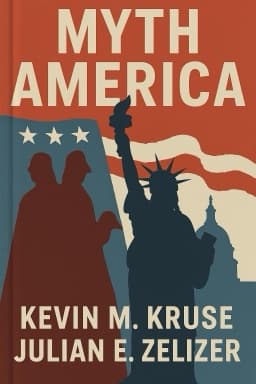
Kevin M. Kruse, Julian E. Zelizer (editors)
A scholarly collection debunking major myths about American history and their impact on contemporary politics and culture.
The term 'American exceptionalism' was first used by American communists in the 1920s as a critique, not a compliment.
Section 1
9 Sections
In the vast tapestry of American history, few ideas have been as enduring and yet as misunderstood as the notion of American exceptionalism. Originally coined in the 1920s, not as a badge of honor but as a critical observation, this concept emerged from the halls of communist thought to explain why the United States diverged from the expected path of socialist evolution.
Tracing the journey of American exceptionalism reveals a fascinating evolution. Early on, it was a tool of critique, used to highlight the stubborn resilience of capitalism in the US. Yet, as decades passed, the term was transformed into a symbol of moral and political superiority, embraced by politicians and citizens alike as evidence of the nation's unique destiny.
One of the most striking chapters in this transformation occurred in the 1990s, when a prominent political figure took the concept and wielded it as a weapon against ideological opponents. By asserting that America was not just different but superior, this leader galvanized a conservative base and framed the political Left as unpatriotic and out of touch.
Underlying these political maneuvers are deeper historical narratives that Americans have long told themselves. The Puritan settlers' vision of a 'city upon a hill' cast the nation as a beacon of virtue and divine purpose. The myth of the frontier painted a picture of restless expansion and opportunity. Yet, woven through these tales are threads of racialized superiority and moral contradictions that complicate the story of American greatness.
Together, these elements form a complex mosaic of belief, myth, and political utility. They remind us that the stories a nation tells about itself are never static but evolve with its needs and challenges. As we move forward, understanding this history allows us to critically engage with the myths that shape our identity and politics.
With this foundation laid, we now turn to the myths surrounding the very birth of the nation itself—the founding myths that have shaped constitutional understanding and political identity for centuries.
What was the original context in which 'American exceptionalism' was coined?
17 more quizzes available in app
From academic critique to political slogan
8 more insights available in app
Unlock all 9 sections, 9 insights, full audio, and interactive mind map in the SnapBooks app.
Discover the surprising origins and political evolution of the myth that America is uniquely virtuous and destined for greatness.
Read articleBeyond borders and flags: uncovering the United States’ multifaceted empire and its global reach.
Read article