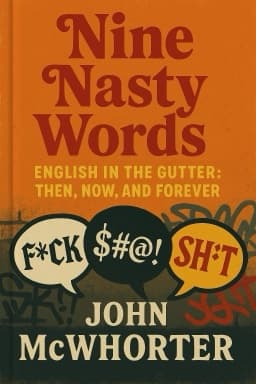
John McWhorter
An insightful linguistic and cultural journey into nine core English profanities, revealing their origins, evolution, and social significance.
The word 'fuck' was once so taboo that it was omitted from dictionaries for centuries.
2 more facts available in the app
Section 1
7 Sections
Imagine stepping back in time to a world where language carried not just meaning but immense moral weight. Words like 'damn' and 'hell' were not mere expressions of frustration but solemn invocations of divine judgment.
In the flickering candlelight of medieval rooms, common folk and nobles alike would avoid uttering such words casually. Instead, they developed a rich tapestry of euphemisms—'darn', 'heck', 'gosh'—to navigate the delicate balance between expressing human emotion and respecting divine authority. These softened forms allowed people to vent frustration without risking social or spiritual censure.
Consider how 'damn' evolved from the Latin 'damnare', meaning 'to condemn', passing through French into English. Despite its serious origins, by the 19th and 20th centuries, 'damn' had become a common exclamation, even appearing in early films and literature with little fanfare. Yet, the shadow of its sacred past lingered, prompting polite society to maintain a veneer of propriety.
Similarly, 'hell' began as a term for the underworld, paralleling Greek 'Hades' and Hebrew 'Sheol'. Its journey from a feared place of torment to a mild expletive illustrates language's fluidity. In colloquial use, 'hell' became an intensifier and a scalar particle, adding emphasis and emotional color to everyday speech.
These transformations highlight how profanity is not static but evolves with culture and cognition. The shift from religious to bodily taboos marks a broader societal change—from fearing divine retribution to managing social boundaries around the body and identity.
In this light, profanity becomes a mirror reflecting human nature—our need to express, to transgress, and to connect emotionally. The journey of 'damn' and 'hell' sets the stage for understanding the more potent profanities to come, revealing how language navigates the sacred and the profane.
As we move forward, we will encounter words whose power and complexity surpass these early bad words, delving deeper into the emotional and social fabric of language.
What was the original significance of the words 'damn' and 'hell' in English?
13 more quizzes available in app
Understanding how early profanities were tied to religious taboos explains their initial power and social restrictions.
8 more insights available in app
Unlock all 7 sections, 9 insights, full audio, and interactive mind map in the SnapBooks app.
Discover how ancient sacred words transformed into everyday expressions that shape our emotions and social interactions.
Read articleUnlock the surprising health and social benefits of swearing backed by science and cultural insights.
Read article