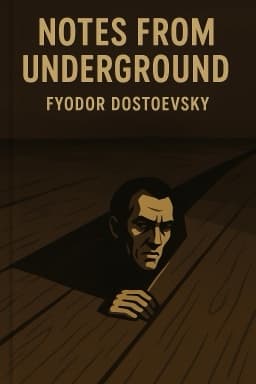
Fyodor Dostoevsky
A profound exploration of human consciousness, free will, and alienation through the conflicted voice of the Underground Man.
Notes from Underground is considered one of the first existentialist novels.
Section 1
6 Sections
In the shadowed depths of a cramped underground room, a man sits alone, wrestling with the paradox of his very existence. He begins by declaring,
Our narrator's heightened self-awareness is a double-edged sword. On one hand, it grants him insight into his own flaws and the world around him; on the other, it traps him in a cycle of overthinking and paralysis. He describes this consciousness as a sickness, a condition that isolates him from others and from action itself.
His torment includes a strange pleasure derived from the awareness of his own humiliation and impotence. He describes moments when, despite knowing the futility of his suffering, he indulges in it, savoring the bitterness like a secret luxury. This paradoxical pleasure is a key to understanding the narrator's psyche — a man who finds meaning in the very act of suffering and self-loathing.
He contrasts himself with the 'normal man,' one who acts simply because he is dull and narrow-minded, who finds a primary cause for his actions and thus moves forward unhesitatingly. The Underground Man envies such simplicity but remains trapped in his own complex web of doubts and desires. His spite, intended as revenge, dissolves into a chemical breakdown, leaving him with nothing but a cold, venomous spite that he nurtures for decades.
Imagine a man who, for forty years, recalls every slight, every humiliation, adding layers of imagined offenses and fantasies, never forgiving, never forgetting. This is the essence of his existence — a conscious burying alive in his own underground. Yet, he admits he is not a hero but a 'vile little fellow,' a chenapan, whose moans and complaints are crafted with the cunning of a connoisseur of pain.
Such consciousness, while agonizing, affirms his individuality. He refuses to accept a life where desires are dictated by reason or profit alone. Instead, he clings to his caprice, his right to want what may be harmful or irrational.
As this section closes, we see a man caught in the paradox of his own making — aware, suffering, yet defiantly alive. His story invites us to question the nature of consciousness, free will, and the human condition. From this foundation, we move into the deeper philosophical debates that shape his world and ours.
How does the Underground Man view his heightened consciousness?
11 more quizzes available in app
The narrator’s self-awareness is both a source of torment and a defining trait.
7 more insights available in app
Unlock all 6 sections, 8 insights, full audio, and interactive mind map in the SnapBooks app.
Dive deep into the tortured mind of literature’s most complex antihero and uncover why his paradoxes still resonate today.
Read articleA deep dive into the psychological and philosophical layers that make The Underground Man a timeless study of human nature’s darker side.
Read article