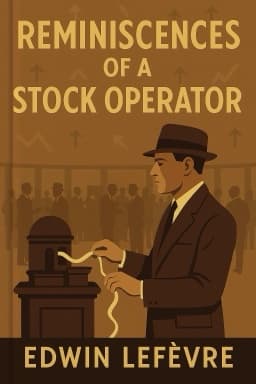
Imagine a young boy, barely out of grammar school, standing before a towering quotation board, chalk in hand, his mind alive with numbers. The world he inhabits is not one of textbooks and teachers, but of bustling men, urgent whispers, and the ceaseless clatter of the ticker tape. While others see only a blur of changing figures, he sees patterns—subtle repetitions, the rhythm of prices rising and falling like the tide. It is here, among the chalk dust and chatter, that the seed of a market mind is planted.
Our story begins not with grand fortunes, but with small, almost invisible victories. The boy, gifted in mental arithmetic, is quick to spot connections others miss. He watches as numbers dance across the board, and in their movement, he senses meaning. He keeps a notebook, jotting down his observations, not to boast imaginary riches, but to test and refine his instincts. Each day, he compares what he thought would happen with what actually did. This quiet discipline, this devotion to learning from experience, becomes his first teacher.
In the world of the bucket shop, the stakes are low but the lessons are sharp. Here, a few dollars can be wagered on the fate of a stock, and the outcome is swift. The boy’s first profit—a mere $3.12—is more than a sum; it is validation. He learns that knowledge, not luck, is the true currency of the market. He discovers that when his observations align with reality, even a small victory can be transformative.
But this environment is not without peril. The bucket shop is a place of constant temptation, where the line between speculation and gambling is thin. The boy sees others, drawn by rumors and tips, lose their savings in a single afternoon. He learns early that following the crowd is rarely the path to success. Instead, he trusts his own system, his own careful study of the tape.
As the boy grows, so does his ambition. He moves from small bets to larger risks, always guided by the patterns he has come to understand. The bucket shops begin to recognize him—not as a lucky gambler, but as a threat to their profits. They bar him from trading, forcing him to seek new arenas. Yet every closed door is a lesson in resilience. He realizes that the market is not a place of certainty, but of endless possibility, where each day brings new patterns to decipher.
And so, with a heart full of curiosity and a mind sharpened by numbers, our young trader sets out on a journey that will take him from the backrooms of betting parlors to the grand halls of Wall Street. He carries with him the lessons of pattern recognition, the discipline of self-testing, and the quiet confidence that comes from knowing he can see what others cannot.
As we leave this first chapter of his life, we are reminded that every journey begins with observation and courage. The next section will reveal what happens when early lessons meet the harsh realities of risk and reward, and how failure can be the greatest teacher of all.