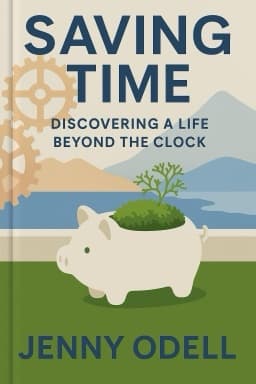
Jenny Odell
An insightful critique of capitalist time, exploring alternative temporalities and the politics of time in work, leisure, and ecology.
The term 'time is money' was popularized during the rise of industrial capitalism but has roots in much older moral and religious ideas about the value of time.
Section 1
10 Sections
Imagine a world where time was not measured by ticking clocks but by the rising and setting sun, the flow of water, or the burning of incense. For centuries, human societies lived with fluid temporalities, where moments were marked by natural cycles and communal rituals. Yet, a profound transformation began with the Christian monastic tradition, where the Rule of Saint Benedict mandated seven prayer times throughout the day and an eighth in the middle of the night. This religious discipline was not merely spiritual; it imposed a rhythm on life that demanded punctuality and order. Monks were punished for idleness or tardiness, and bells tolled to summon them to work or prayer.
Fast forward to the dawn of industrialization, where the clock’s face became not just a spiritual guide but a tool of economic control. Factories demanded workers arrive and depart at precise times, their labor sliced into equal units called hours and minutes. The clock became a foreman, relentless and unforgiving, measuring not just the passage of time but the value extracted from each moment.
The spread of standardized time was accelerated by technological advances like the railway, which required synchronized schedules to avoid chaos and disaster. Before time zones, each town kept its own local time based on the sun, leading to confusion and missed connections. The invention of master clocks sending electrical signals to slave clocks across countries brought a new uniformity, and the International Meridian Conference of 1884 established Greenwich, England, as the prime meridian.
Colonial powers used time as a tool of domination, placing indigenous peoples 'under the bells' of mission stations and grading their progress by how closely they conformed to Western time. This was not just about efficiency but about reshaping entire worldviews and social orders. The clock, then, is never just a neutral instrument but a participant in histories of power, control, and resistance.
As we begin this journey through the nature of time, it is essential to recognize that the time we often take for granted—the 24-hour day divided into equal hours—is a cultural and historical construct. It emerged from specific needs and interests, particularly those of religious institutions, industrial capitalists, and colonial empires. Understanding this helps us see that time is not simply a natural fact but a contested terrain, shaped by human choices and struggles.
In the next section, we will delve deeper into how this commodified time affects our personal lives, especially through the lenses of productivity culture and self-surveillance, revealing the intimate ways in which time governs us beyond the factory floor.
What religious practice contributed to the early structuring of time into segments?
19 more quizzes available in app
The emergence of standardized clock time was deeply intertwined with mechanisms of social and labor control, particularly in religious and industrial contexts.
8 more insights available in app
Unlock all 10 sections, 9 insights, full audio, and interactive mind map in the SnapBooks app.
Discover the radical ideas that challenge our obsession with the clock and offer a new way to live.
Read articleUnveil the surprising origins of standardized time and its role in shaping modern capitalism.
Read article