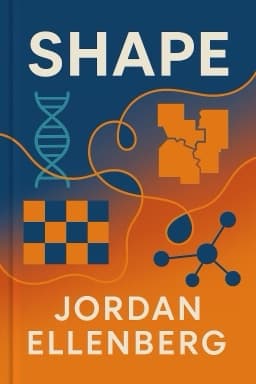
Jordan Ellenberg
An illuminating journey through the pervasive role of geometry in mathematics, nature, strategy, information, and democracy.
Jordan Ellenberg is a mathematician who also writes engagingly for the general public, blending humor with deep insight.
2 more facts available in the app
Section 1
10 Sections
Geometry, often perceived as a dry, dusty relic of schooldays, is in truth a living, breathing discipline that pulses with the vitality of human thought and intuition. From the ancient city of Alexandria over two millennia ago emerged a collection of axioms and propositions that would shape not only mathematics but the very way we reason about the world.
Yet, geometry is not merely the memorization of proofs or the mechanical application of rules. It is the delicate dance between intuition and rigor. Consider the Pons Asinorum, or the 'bridge of asses,' a classical theorem that forces the learner to cross from the realm of obviousness into the disciplined world of proof. This theorem, which states that in an isosceles triangle the base angles are equal, is something our minds sense immediately, yet formalizing this insight demands careful reasoning.
Our relationship with geometry begins long before formal education. Even infants, without words or numbers, display a sensitivity to shapes and symmetry. When shown pairs of images, babies gaze longer at mirrored shapes, indicating an innate geometric intuition that predicts later spatial reasoning skills.
But why do we insist on proofs? Because the world is full of half-truths and fallacies dressed as logic. The habit of rigorous proof trains us to distinguish the genuine from the spurious. It is a mental discipline, akin to honesty, that guards against deception—both from others and ourselves.
At the same time, geometry is not a sterile exercise in formality. It is deeply connected to our physical experience. Mathematicians often find themselves tracing invisible figures with their hands, relying on a bodily sense of shape and motion. This embodied intuition complements formal logic, creating a rich tapestry of understanding.
As we embark on this journey through the hidden geometry of the world, remember that the subject is alive and evolving. It is not confined to dusty textbooks but is a vibrant, expanding field that touches everything from biology to democracy. The next section will take us beyond the axioms into the curious world of holes and topology, where the familiar shapes of our intuition give way to strange and beautiful new landscapes.
What is the primary purpose of Euclid's axioms?
19 more quizzes available in app
Mathematics thrives on the harmony between intuitive understanding and formal proof.
8 more insights available in app
Unlock all 10 sections, 9 insights, full audio, and interactive mind map in the SnapBooks app.
Discover how geometry shapes everything from the smallest insect flight paths to the fairness of our elections.
Read articleHow geometric and probabilistic models power modern AI and decode the hidden patterns of language.
Read article