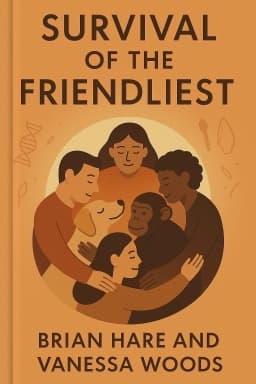
Brian Hare and Vanessa Woods
Human evolution and survival hinge on friendliness and cooperation, which foster social bonding, communication, and cultural innovation, while also explaining our capacity for both kindness and cruelty.
Dogs can understand human pointing gestures better than chimpanzees, a result of domestication.
2 more facts available in the app
Section 1
8 Sections
Imagine a classroom where children from different backgrounds no longer compete bitterly but instead depend on each other to learn. This simple shift from competition to cooperation is at the heart of a powerful educational innovation that transformed classrooms across the United States. When each child is given a unique piece of knowledge and must teach it to their peers, the children quickly realize that their success hinges on their friends' understanding, not just their own.
Popular culture has long embraced the phrase 'survival of the fittest' as a justification for ruthless competition, but biology tells a more nuanced story. 'Fitness' in evolution refers to the ability to survive and reproduce, not necessarily physical dominance or aggression. In fact, aggression can be costly, leading to stress, injury, and fewer offspring.
These ideas invite us to reconsider our assumptions about human nature and success. Far from being solitary warriors, our ancestors thrived because they could cooperate, communicate, and build friendships. This foundation of friendliness set the stage for the cultural and technological explosion that defines modern humanity.
As we move forward, we will explore how this evolutionary path is mirrored in our closest relatives and domesticated animals, and how it shapes the very essence of what it means to be human.
What educational method helped reduce racial hostility by promoting cooperation?
15 more quizzes available in app
Friendliness and cooperation increase evolutionary fitness more reliably than aggression.
8 more insights available in app
Unlock all 8 sections, 9 insights, full audio, and interactive mind map in the SnapBooks app.
Unlock the surprising power of friendliness that shaped humans and animals alike — and how it can transform your life today.
Read articleDiscover the extraordinary science behind friendliness—from animal domestication to human society—and why it matters now more than ever.
Read article
Herman Pontzer, PhD
Lisa Randall

John Hands
Carlo Rovelli
