Carl Richards
A practical guide to overcoming emotional and behavioral pitfalls in personal finance.
Carl Richards is famous for his simple, hand-drawn sketches that illustrate complex financial ideas—many of which appear in The New York Times and in this book.
Section 1
7 Sections
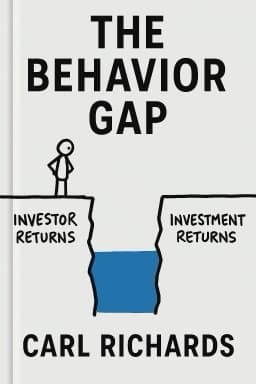
Welcome, friend, to a gentle exploration of why we so often do the exact opposite of what we know is wise with our money. Imagine standing on the edge of a canyon, gazing across at a distant ledge. On one side is what your investments could earn, on the other is what you actually receive. This is the 'behavior gap'—an invisible but very real space where hopes, dreams, and fears twist our intentions into actions that cost us dearly.
Let’s start with a simple truth: if you had just bought an average mutual fund and left it alone, you’d likely be much richer today. But most people don’t. We’re tempted by headlines, swayed by our neighbor’s stories of quick wins, or spooked by the latest market drop. We jump in and out, chasing the next big thing or fleeing at the first sign of trouble.
It’s not just in stocks. The same behavior gap appears in real estate, bonds, and even cash management. Whenever emotion trumps logic, the gap widens. And it’s not just you or me—researchers have tracked this across millions of investors, finding that the average person earns far less than the investments they choose, simply because of their own actions.
What’s fascinating is how universal this is. The sketches that made these ideas famous—a simple line, a gap, a stick figure—resonate around the world. They remind us that, no matter our background, we’re all vulnerable to the same emotional traps.
As we continue, we’ll uncover the roots of these behaviors, and learn how to gently steer ourselves toward better outcomes. Next, let’s look at how simplifying our financial choices can be the most powerful step toward peace and prosperity.
What is the 'behavior gap'?
13 more quizzes available in app
The measurable difference between what investments earn and what investors actually receive.
7 more insights available in app
Unlock all 7 sections, 8 insights, full audio, and interactive mind map in the SnapBooks app.
Dave Ramsey

Chris Hogan

Vivian Tu
Thomas J. Stanley, Ph.D. and William D. Danko, Ph.D.
