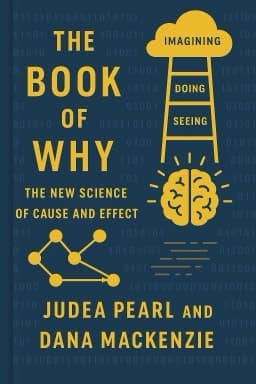
Judea Pearl and Dana Mackenzie
A transformative exploration of causal inference that bridges statistics, AI, and philosophy to unlock the science of cause and effect.
The concept of the 'Ladder of Causation' categorizes reasoning into three levels: association, intervention, and counterfactuals.
Section 1
10 Sections
Imagine standing at the foot of a grand ladder, each rung representing a deeper level of understanding about the world around us. This is the Ladder of Causation, a powerful metaphor that unlocks how we think about cause and effect. At the first rung, we see association: the simple recognition of patterns and correlations. For instance, noticing that ice cream sales and drowning incidents both rise in summer. But does one cause the other? This level is about observation and pattern recognition, something many animals and current AI systems excel at. Yet, it is limited.
Step up to the second rung, intervention, where we ask, 'What happens if I do something?' This is a profound leap. It is the difference between watching the world and acting upon it, predicting the consequences of our actions. For example, what will happen if we raise the price of toothpaste? This question demands causal knowledge, not just data. It requires understanding that changing a variable can alter outcomes in ways that mere observation cannot reveal.
At the top of the ladder lies counterfactual reasoning: the ability to imagine alternate realities and ask, 'What if things had been different?' This is the realm of imagination and explanation. It allows us to ponder why events occurred and what might have been if we had acted differently. This level is uniquely human and underpins our capacity for regret, responsibility, and moral judgment. For example, if a patient dies after taking a drug, we can ask, 'Would they have lived if they had not taken it?' Such questions cannot be answered by experiments or data alone but require a causal model that connects facts to possibilities.
These three levels form a hierarchy: association is necessary but insufficient for intervention, which in turn is necessary but insufficient for counterfactuals. Each level unlocks new questions and capabilities. Traditional statistics and machine learning mostly dwell on association, explaining why they struggle with causal questions. The Ladder of Causation invites us to climb higher, harnessing causal diagrams—simple dot-and-arrow maps of cause and effect—to navigate these complex terrains.
Consider a firing squad scenario: observing that the prisoner is dead allows us to infer that the soldiers fired (association). But if we imagine forcing one soldier to fire independently (intervention), we can predict the outcome differently. Finally, by imagining the soldier refraining from firing (counterfactual), we explore alternate histories and causation. This rich understanding arises from grasping the difference between seeing and doing, between data and causal knowledge.
As we embark on this journey through the science of cause and effect, remember that data alone are profoundly dumb about causality. It is our human intelligence that interprets, intervenes, and imagines. This audiobook will guide you through these levels, revealing how causal inference reshapes science, AI, and our understanding of the world.
Now, let us delve into the roots of causal thinking, exploring the historical struggles and breakthroughs that paved the way for this revolution.
What are the three levels of the Ladder of Causation?
19 more quizzes available in app
A framework that categorizes causal reasoning into three levels, each with increasing complexity and power.
8 more insights available in app
Unlock all 10 sections, 9 insights, full audio, and interactive mind map in the SnapBooks app.
Dive deep into the revolutionary ideas that are reshaping how we understand causality in science and AI.
Read articleA deep dive into why understanding causality is the missing piece in AI and scientific discovery.
Read article
Max Tegmark

Vaclav Smil

J. Craig Venter

Michio Kaku
