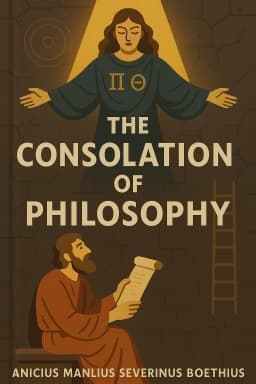
Anicius Manlius Severinus Boethius
A profound philosophical dialogue exploring happiness, fortune, evil, and free will, written by Boethius during his imprisonment.
Boethius wrote The Consolation of Philosophy while imprisoned and awaiting execution.
2 more facts available in the app
Section 1
9 Sections
Imagine yourself in a quiet prison cell, where a man wrestles with the deepest questions of life. He has lost everything external—wealth, power, and status—and now seeks what all humans desire most: true happiness.
Many chase after fortune’s favors, believing that wealth or fame can bring lasting joy. Yet, like the turning wheel of Fortune itself, these gifts are unstable and often betray their recipients.
What then is true happiness? It is a state that contains all good within itself, leaving nothing more to be desired. Unlike wealth or power, which can be lost or diminished, true happiness is whole and unchanging. It is not a part or fragment but the complete good, the ultimate goal toward which all human striving naturally turns.
Consider the analogy of a house built on rock versus sand. The house on sand is vulnerable to storms and collapse, much like happiness rooted in external things. But the house on rock stands firm through all tempests, symbolizing happiness grounded in eternal and unchangeable good.
This first insight sets the tone for our journey: to distinguish between the fleeting and the permanent, the false and the true, and to prepare for a deeper understanding of how the soul can find peace amidst life’s turmoil.
As we leave behind the illusions of fortune, we turn now to understand the very nature of Fortune herself, the fickle force that governs the rise and fall of worldly things.
What is true happiness according to the philosophy presented?
17 more quizzes available in app
Happiness is the highest good, perfect and self-contained, unlike fleeting external goods.
7 more insights available in app
Unlock all 9 sections, 8 insights, full audio, and interactive mind map in the SnapBooks app.
Discover how a 6th-century philosophical masterpiece offers timeless guidance on happiness, fate, and the human soul.
Read articleLearn to embrace change and uncertainty with the ancient wisdom of Boethius’ philosophical masterpiece.
Read article