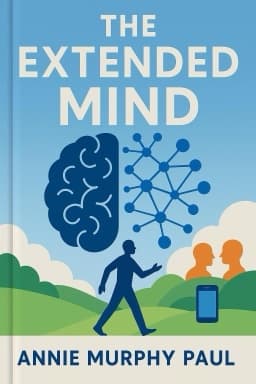
Annie Murphy Paul
A groundbreaking exploration of how cognition extends beyond the brain to include body, environment, and social interaction, enhancing thinking and learning.
The concept of the extended mind was first formally proposed by philosophers Andy Clark and David Chalmers in 1998.
2 more facts available in the app
Section 1
7 Sections
Imagine a quiet moment where you close your eyes and tune into the rhythm of your own heartbeat.
Mindfulness practices such as the body scan meditation train us to gently observe these sensations without judgment, enhancing our connection to this inner guidance.
Our emotions themselves are not dictated solely by the brain’s commands but are constructed from the very sensations flowing through our bodies. The racing heart and sweaty palms do not follow fear; they create it. This reversal of the usual story invites us to participate actively in shaping our emotional experiences through awareness and reinterpretation. For instance, reappraising nervousness as excitement can boost performance in challenging tasks, turning discomfort into an energizing force.
Moreover, this bodily wisdom extends beyond self-awareness. When we interact with others, our bodies mimic their expressions and postures, allowing us to 'feel' their emotions internally. This social interoception deepens empathy and connection, making us more attuned to the feelings of those around us.
In essence, the body is not a mere vessel for the brain but a vital partner in thought and feeling — a somatic rudder steering us through the complexities of life. As we embrace this perspective, we open ourselves to a richer, more integrated way of knowing and being.
As we begin to understand the body's role in cognition, we naturally turn to consider how movement itself shapes our thinking — a journey we will explore next.
What is interoception?
13 more quizzes available in app
Our ability to sense internal bodily signals improves judgment and financial success.
8 more insights available in app
Unlock all 7 sections, 9 insights, full audio, and interactive mind map in the SnapBooks app.
Discover how your mind stretches beyond your brain to your body, environment, and social world — and how to harness this for better thinking and creativity.
Read articleDiscover how simple physical movements like walking and fidgeting can supercharge your brainpower and creative output.
Read article