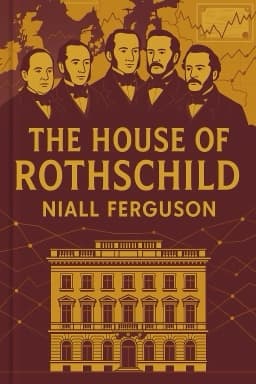
Niall Ferguson
A detailed historical account of the Rothschild banking dynasty’s rise, influence, and legacy in 19th-century Europe.
The Rothschild family name means 'Red Shield' in German, originally referring to a house sign in the Frankfurt ghetto.
Section 1
8 Sections
Imagine a narrow, crowded street in 18th-century Frankfurt, called the Judengasse. This was the confined quarter where the Jewish community lived, enclosed by high walls and gates, a place both sanctuary and prison. Over 3,000 souls lived squeezed into this quarter, where houses were no more than twelve feet wide and four stories tall, packed tightly together. Life here was harsh; mortality rates were high, and freedom was limited. Yet, in this constrained environment, a remarkable story was unfolding.
Mayer Amschel was not born a banker. His early years were shaped by a rigorous education steeped in Jewish religious traditions, but also by practical business training. At the age of twelve, orphaned by an epidemic, he was sent to Hanover to apprentice under a dealer who was well-connected to European courts. Here, Mayer Amschel learned the trade of rare coins and antiques, a business that brought him into contact with aristocrats and collectors.
Back in Frankfurt, Mayer Amschel established himself as a dealer in coins and medals, gradually gaining the patronage of the Hereditary Prince of Hesse-Kassel. This relationship was not merely transactional; it was the beginning of a long-term alliance that would define the Rothschilds’ rise. The prince’s trust led to Mayer Amschel’s appointment as court agent, a prestigious position that allowed him to manage the prince’s finances and lend money on his behalf.
The Rothschilds’ story is one of turning adversity into opportunity. The Judengasse was a place of confinement, but it also forged a resilient spirit. The family’s early business was deeply rooted in the limited economic niches available to Jews at the time, such as money-changing, bill broking, and antique dealing.
As we move forward in this journey, we will see how Mayer Amschel’s sons expanded this modest business into a multinational financial powerhouse, leveraging family bonds and innovative financial techniques. From these cramped streets and humble beginnings, a family would emerge to shape the financial world of the 19th century.
Let us now turn to how the Rothschilds transformed banking and created a new form of multinational financial partnership that would dominate European finance.
What was the Judengasse?
15 more quizzes available in app
The Rothschilds began in a confined, restrictive environment that shaped their resilience and business acumen.
8 more insights available in app
Unlock all 8 sections, 9 insights, full audio, and interactive mind map in the SnapBooks app.
Discover the incredible journey of the Rothschilds from a cramped Frankfurt ghetto to the pinnacle of global banking power.
Read articleExplore the revolutionary financial methods pioneered by the Rothschild dynasty that still shape global markets today.
Read article