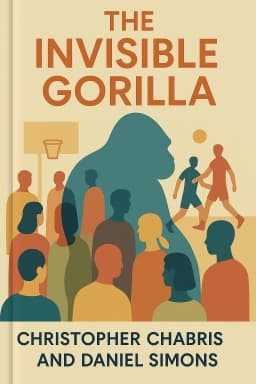
Christopher Chabris and Daniel Simons
A compelling exploration of cognitive illusions that distort our attention, memory, confidence, and decision-making.
The original gorilla experiment was awarded an Ig Nobel Prize for achievements that first make people laugh, then think.
Section 1
9 Sections
Imagine watching a basketball game where two teams pass a ball back and forth. Your task is to count the number of passes made by one team. You focus intently on the players and the ball, your eyes glued to their every move. Suddenly, a person in a gorilla suit walks right through the middle of the game, thumping their chest and then walking off.
Our brains are wired to focus attention on specific tasks or objects, filtering out everything else. This selective attention is essential for navigating a complex world, but it comes at the cost of missing unexpected events, even when they are right in front of us. Eye-tracking studies show that people often look directly at the gorilla but don't consciously see it.
This limitation is not a failure of vision or intelligence. Even trained professionals—police officers chasing suspects, pilots landing planes, radiologists reading scans—can miss critical information when their attention is elsewhere. For example, a police officer once failed to see a colleague being assaulted right next to him during a chaotic chase, leading to wrongful accusations and convictions. Pilots have failed to notice planes on runways, and radiologists have overlooked unexpected objects in medical images, all due to the limits of attention.
The illusion that we can see and process everything around us is deeply ingrained. We believe that if we are looking, we must be seeing, but the reality is more sobering. Our mental focus acts like a spotlight, illuminating only a small portion of our surroundings. The rest fades into invisibility, unnoticed and unregistered.
Understanding inattentional blindness is the first step toward recognizing the limits of our awareness. It teaches us humility and caution, especially in situations requiring vigilance and quick decisions. The next section will explore how our memories, like our attention, can deceive us, reshaping our understanding of the past in surprising ways.
What percentage of people typically fail to notice the gorilla in the famous experiment?
17 more quizzes available in app
Focused attention can cause us to miss unexpected but visible objects.
8 more insights available in app
Unlock all 9 sections, 9 insights, full audio, and interactive mind map in the SnapBooks app.
Discover how your brain tricks you into missing what’s right in front of you—and what that means for your daily life.
Read articleUncover the surprising science behind false memories and how your brain rewrites your past.
Read article